More About This Card
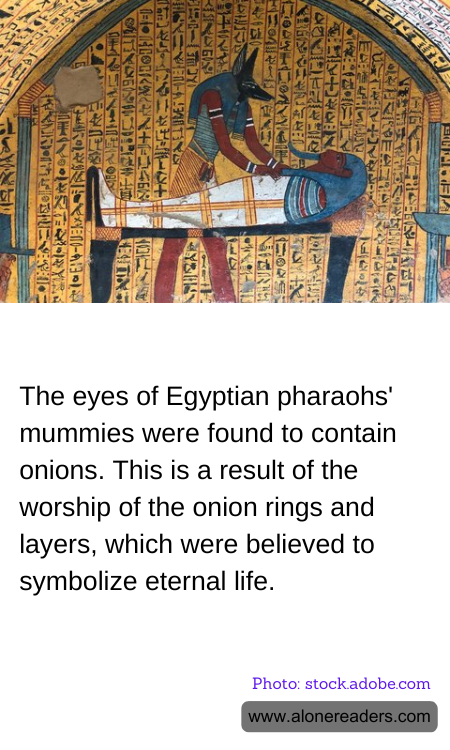
In the annals of ancient Egyptian history, the mummification process stands as a testament to the civilization's profound beliefs about life, death, and the afterlife. Among the many intriguing discoveries made by archaeologists, one peculiar finding has captured the imagination of historians and the public alike: the presence of onions in the eye sockets of Egyptian pharaohs' mummies. This curious practice is not merely a quirk of ancient embalming techniques but is deeply rooted in the symbolic significance of the onion in Egyptian culture.
The onion, with its concentric rings and layers, was revered by the ancient Egyptians as a symbol of eternal life. This belief was likely inspired by the onion's structure, which seemed to represent the infinite layers of existence and the cyclical nature of life and death. The Egyptians, who were meticulous in their religious and spiritual practices, saw the onion as a powerful emblem of the universe's eternal cycle. Its round shape and layered composition were thought to mirror the universe's complexity and the soul's journey through the afterlife.
Incorporating onions into the mummification process was a way to ensure that the deceased would be protected and guided in their journey to the afterlife. Placing onions in the eye sockets of mummies was a symbolic act, intended to provide the deceased with the ability to see and navigate the afterlife. It was believed that the onion's protective qualities would help ward off evil spirits and ensure a safe passage to the realm of the gods. This practice underscores the Egyptians' deep-seated belief in the interconnectedness of life and death and their desire to secure immortality for their revered leaders.
The worship of the onion in ancient Egypt extended beyond its use in mummification. Onions were also used in religious rituals and offerings to the gods. They were considered sacred and were often depicted in tomb paintings and temple carvings. The onion's pungent aroma and medicinal properties further enhanced its status as a revered plant, believed to possess the power to heal and protect.
Today, the discovery of onions in the mummies of Egyptian pharaohs offers a fascinating glimpse into the spiritual and cultural practices of one of history's most enigmatic civilizations. It highlights the Egyptians' sophisticated understanding of symbolism and their unwavering belief in the afterlife. As we continue to uncover the mysteries of ancient Egypt, the humble onion serves as a reminder of the enduring legacy of a civilization that sought to transcend the boundaries of life and death through the power of symbolism and ritual.