More About This Card
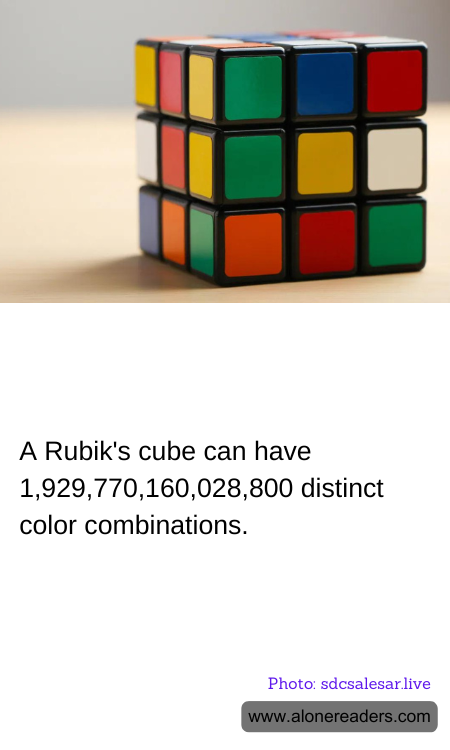
The Rubik's Cube, a seemingly simple yet profoundly complex puzzle, has fascinated minds across the globe since its invention in 1974 by Hungarian architect Erno Rubik. At first glance, it appears to be a straightforward challenge: align the colors on each of the cube's six faces. However, beneath its colorful exterior lies a staggering mathematical complexity. The Rubik's Cube can be arranged in an astonishing 1,929,770,160,028,800 distinct color combinations, a number that underscores the depth of this iconic puzzle.
To appreciate the enormity of this figure, consider that it is over 1.9 quintillion possible configurations. This number is so vast that if you were to attempt a new combination every second, it would take you over 60 billion years to explore them all. This mind-boggling number is a result of the cube's structure: each of the six faces has nine stickers, and the cube can be twisted and turned in numerous ways, leading to a multitude of permutations.
The Rubik's Cube is not just a test of patience and dexterity; it is also a fascinating study in mathematics and logic. The puzzle's complexity arises from its group theory, a branch of mathematics that studies symmetrical structures. Solving the cube involves understanding these permutations and applying algorithms—sequences of moves that manipulate the cube's pieces in a controlled manner. These algorithms are the key to unlocking the cube's secrets and achieving the goal of a uniform color on each face.
Despite its complexity, the Rubik's Cube is accessible to people of all ages. It serves as an educational tool, teaching problem-solving skills, spatial awareness, and perseverance. Many enthusiasts find joy in the challenge of solving the cube, while others are drawn to the competitive aspect, participating in speedcubing competitions where solvers race against the clock to complete the puzzle in record time. The current world record for solving a standard 3x3 cube is under four seconds, a testament to the skill and dedication of these speedcubers.
The Rubik's Cube has also found its place in popular culture, appearing in movies, art, and even music. Its vibrant colors and geometric design make it an enduring symbol of intellectual curiosity and creativity. As technology advances, the cube continues to evolve, with digital versions and apps bringing the puzzle to new audiences.
In conclusion, the Rubik's Cube is much more than a simple toy. It is a mathematical marvel, a cultural icon, and a source of endless fascination. Its 1,929,770,160,028,800 possible combinations remind us of the complexity and beauty of mathematics, while its enduring popularity speaks to the universal appeal of a good challenge. Whether you're a seasoned solver or a curious beginner, the Rubik's Cube offers a world of exploration and discovery, one twist at a time.