More About This Card
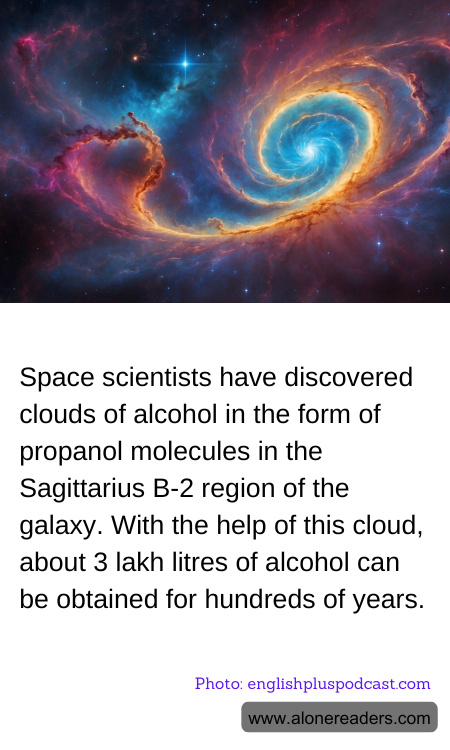
In a remarkable discovery that has captured the imagination of both scientists and the public alike, space researchers have identified clouds of alcohol in the form of propanol molecules in the Sagittarius B-2 region of our galaxy. This finding not only adds to our understanding of the complex chemistry of space but also opens up intriguing possibilities for the future of space exploration and resource utilization.
Sagittarius B-2 is a massive molecular cloud located near the center of the Milky Way, approximately 390 light-years from Earth. It has long been a subject of interest for astronomers due to its rich chemical composition. The recent detection of propanol, a type of alcohol, adds to the growing list of organic molecules found in this region. Propanol is a three-carbon alcohol that exists in two isomeric forms: n-propanol and iso-propanol. The presence of these molecules in space suggests that the building blocks of life are more widespread in the universe than previously thought.
The discovery was made using advanced radio telescopes that can detect the specific frequencies emitted by molecules in space. These telescopes are capable of identifying the unique spectral signatures of different compounds, allowing scientists to pinpoint the presence of propanol among the myriad of other molecules in the cloud. The significance of this discovery lies not only in its contribution to astrochemistry but also in its potential implications for the future.
The sheer volume of propanol in the Sagittarius B-2 cloud is staggering. It is estimated that the cloud contains enough alcohol to produce approximately 300,000 liters, a quantity that could theoretically supply alcohol for hundreds of years. While the practicalities of harvesting this cosmic alcohol are currently beyond our technological capabilities, the concept itself is a fascinating glimpse into the potential resources that space might offer.
This discovery also raises questions about the role of such molecules in the formation of life. Organic compounds like propanol are considered essential precursors to more complex molecules, such as amino acids and proteins, which are the building blocks of life as we know it. The presence of these molecules in space supports the theory that the ingredients for life could be widespread throughout the universe, potentially seeding life on other planets.
While the idea of tapping into a cosmic alcohol reservoir may seem like science fiction, it underscores the importance of continued exploration and study of our galaxy. As technology advances, the ability to utilize space-based resources could become a reality, offering new opportunities for scientific discovery and perhaps even the future of human civilization.
In conclusion, the discovery of propanol clouds in the Sagittarius B-2 region is a testament to the wonders of the universe and the relentless pursuit of knowledge by space scientists. It highlights the intricate and often surprising chemistry of space, while also sparking the imagination about what other secrets the cosmos might hold. As we continue to explore the vastness of space, who knows what other extraordinary discoveries await us?