More About This Card
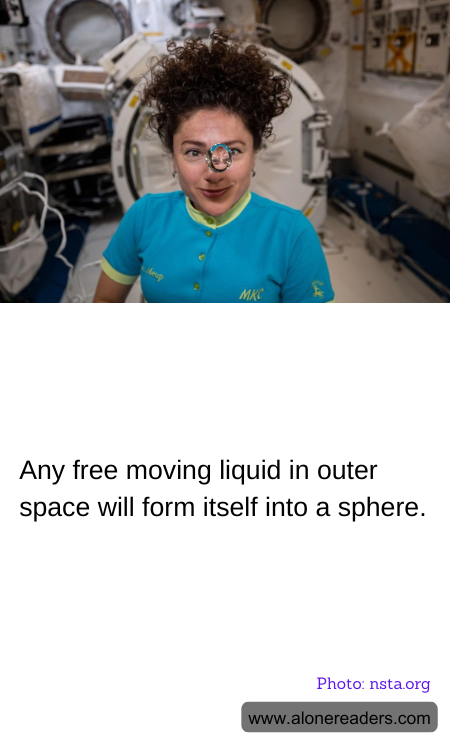
In the vast expanse of outer space, where gravity as we know it on Earth is virtually absent, liquids behave in fascinating ways that defy our everyday experiences. One of the most intriguing phenomena observed in this zero-gravity environment is that any free-moving liquid will naturally form itself into a sphere. This spherical formation is a direct consequence of the unique conditions present in space and the fundamental properties of liquids.
On Earth, gravity plays a dominant role in shaping the behavior of liquids. When you pour water into a glass, gravity pulls it downwards, and the liquid conforms to the shape of its container. However, in the microgravity environment of space, the absence of a strong gravitational pull allows other forces to take precedence. Surface tension, a property of liquids that causes them to minimize their surface area, becomes the primary force at play.
Surface tension is the result of cohesive forces between liquid molecules. These forces pull the molecules towards each other, creating a sort of 'skin' on the liquid's surface. In space, without gravity to flatten or distort the liquid, surface tension causes the liquid to pull itself into the shape that has the smallest possible surface area for a given volume: a sphere. This is why astronauts aboard the International Space Station often play with floating droplets of water, which appear as perfect, shimmering spheres.
The spherical shape is not only aesthetically pleasing but also scientifically significant. It demonstrates the balance of forces at work in a microgravity environment and provides insights into fluid dynamics that are not easily observed on Earth. This behavior has practical applications in various fields, including space exploration and technology development. For instance, understanding how liquids behave in space is crucial for designing fuel tanks for spacecraft, where the efficient management of liquid fuel is essential for mission success.
Moreover, the study of liquids in space has implications for biological and chemical research. Scientists can conduct experiments in microgravity to better understand processes such as protein crystallization and the behavior of biological cells, which can lead to advancements in medicine and materials science.
In conclusion, the natural tendency of free-moving liquids to form spheres in outer space is a captivating demonstration of the interplay between surface tension and the absence of gravity. This phenomenon not only enriches our understanding of physics but also opens up new avenues for scientific exploration and technological innovation. As we continue to explore the cosmos, the simple yet profound behavior of liquids in space will remain a subject of fascination and a testament to the wonders of the universe.