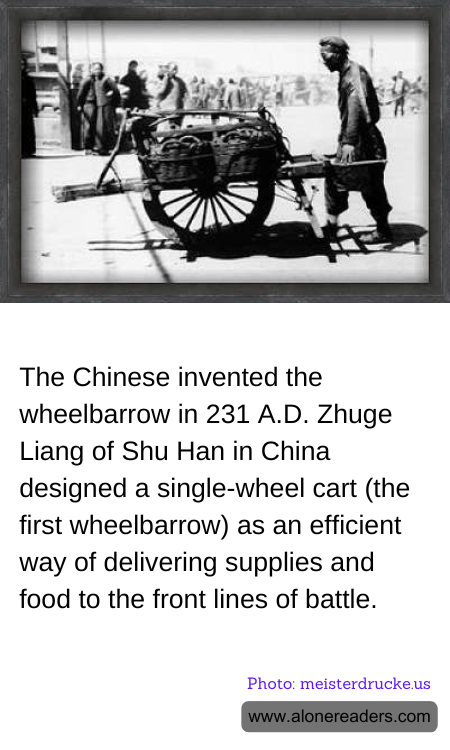
More About This Card
The invention of the wheelbarrow is a fascinating chapter in the history of human innovation, tracing its origins back to ancient China. In 231 A.D., during the tumultuous era of the Three Kingdoms, a brilliant military strategist named Zhuge Liang of Shu Han revolutionized the way supplies were transported to the front lines of battle. His ingenious design of a single-wheel cart, which we now recognize as the wheelbarrow, marked a significant advancement in logistics and efficiency.
Zhuge Liang, renowned for his intellect and strategic acumen, faced the daunting challenge of ensuring that his troops were well-supplied during military campaigns. The rugged and often treacherous terrain of ancient China posed significant obstacles to traditional methods of transportation. Recognizing the need for a more efficient solution, Zhuge Liang conceptualized a device that could navigate narrow paths and uneven ground with ease. The result was the single-wheel cart, a simple yet effective tool that could be maneuvered by a single person, allowing for the swift and efficient delivery of food, weapons, and other essential supplies.
The design of the wheelbarrow was both practical and innovative. By placing the wheel at the center of the cart, Zhuge Liang ensured that the weight of the load was evenly distributed, making it easier to push and control. This design not only reduced the physical strain on the operator but also increased the speed and efficiency of supply transportation. The wheelbarrow quickly proved its worth on the battlefield, enabling armies to maintain their strength and resilience by ensuring a steady flow of resources.
Beyond its military applications, the wheelbarrow's impact extended to various aspects of daily life in ancient China. Farmers and laborers adopted the wheelbarrow for agricultural and construction purposes, recognizing its potential to enhance productivity and reduce labor costs. The wheelbarrow's ability to transport heavy loads with minimal effort transformed agricultural practices, allowing for the more efficient movement of crops and materials.
The legacy of Zhuge Liang's invention endures to this day, with the wheelbarrow remaining a ubiquitous tool in gardens, construction sites, and farms worldwide. Its simple yet effective design has stood the test of time, a testament to the ingenuity of its creator. The wheelbarrow's invention not only highlights the innovative spirit of ancient Chinese civilization but also underscores the timeless value of practical solutions in overcoming challenges.
In conclusion, the invention of the wheelbarrow by Zhuge Liang in 231 A.D. represents a pivotal moment in the history of human innovation. This simple yet transformative tool revolutionized the way supplies were transported, both on the battlefield and in everyday life. Its enduring legacy serves as a reminder of the power of creativity and ingenuity in shaping the course of history.