More About This Card
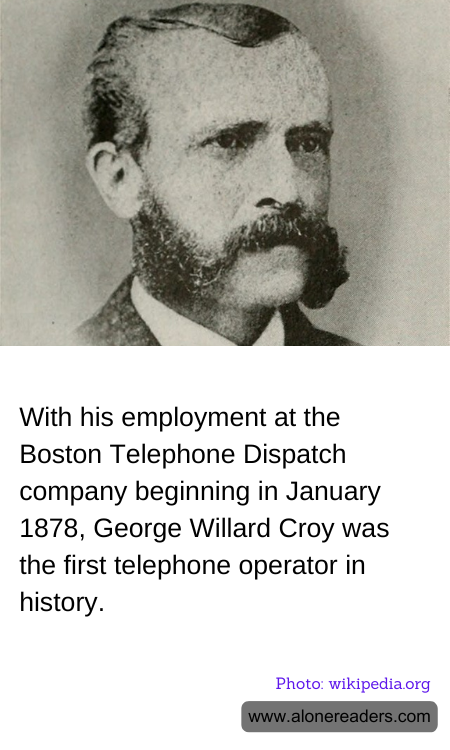
In the annals of communication history, the name George Willard Croy holds a special place. Beginning his employment at the Boston Telephone Dispatch Company in January 1878, Croy became the world's first telephone operator, a role that would evolve significantly over the years and become integral to the development of telecommunication services.
Before the advent of automated systems, telephone operators were essential in connecting calls. In the late 19th century, the telephone was a novel invention, and the concept of a telephone operator was just as new. George Willard Croy's pioneering role marked the beginning of a profession that would become predominantly female and crucial to the expansion of telephone networks worldwide. At the time, the telephone was a cutting-edge technology, and Croy's position was vital in demonstrating its potential and utility to the public.
Croy's work involved manually connecting calls by plugging and unplugging wires on a switchboard, a task that required precision, patience, and a keen understanding of the technology. His role was not just technical; it also required a degree of customer service, as operators were often the first point of contact for users of the new technology. This aspect of the job laid the groundwork for the customer service roles that are so prevalent in today's telecommunications industry.
The significance of Croy's employment goes beyond his technical duties. His position as the first telephone operator highlights the rapid technological advancements of the era and the societal shifts that accompanied them. The telephone was transforming communication, making it faster and more accessible, and operators like Croy were at the forefront of this transformation. They were the human link in a burgeoning network that would soon span the globe.
As the telephone industry grew, so did the demand for operators. By the early 20th century, the role had become predominantly female, as women were believed to have the patience and demeanor suited for the job. This shift also reflects broader social changes, as more women entered the workforce and took on roles that were previously unavailable to them. The profession of telephone operator became a symbol of the changing landscape of work and gender roles.
George Willard Croy's pioneering work as the first telephone operator is a testament to the early days of telecommunication and the human element that was crucial to its success. His contribution laid the foundation for a profession that would become essential to the functioning of modern society. As we look back at the history of communication, Croy's role reminds us of the importance of human ingenuity and adaptability in the face of technological change.