More About This Card
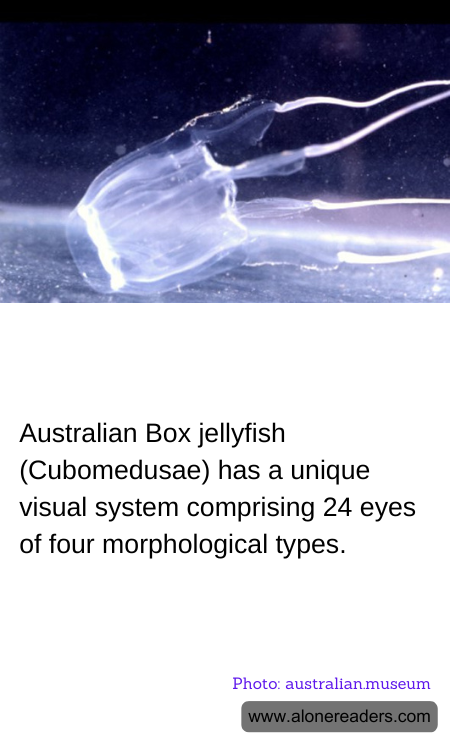
The Australian Box jellyfish, belonging to the class Cubomedusae, is one of the most intriguing and enigmatic creatures of the marine world. Known for its potent venom and ethereal beauty, this jellyfish also boasts a remarkably sophisticated visual system that sets it apart from other marine animals. Unlike most jellyfish, which are often perceived as simple organisms, the Box jellyfish possesses a complex array of 24 eyes, divided into four distinct morphological types, each serving a unique function.
This intricate visual system is housed within the jellyfish's rhopalia, which are sensory structures located around its bell. The four types of eyes include the upper lens eyes, lower lens eyes, pit eyes, and slit eyes. Each type of eye is adapted to perform specific tasks, allowing the jellyfish to navigate its environment with surprising precision. The upper and lower lens eyes are capable of forming images, a rare trait among jellyfish, enabling the Box jellyfish to detect obstacles and potential prey. These eyes are particularly adept at discerning light and dark contrasts, which is crucial for survival in the dimly lit underwater world.
The pit eyes and slit eyes, while not capable of forming images, are sensitive to light intensity and direction. This sensitivity allows the jellyfish to maintain its position in the water column and avoid predators. The combination of these different eye types provides the Box jellyfish with a comprehensive view of its surroundings, facilitating complex behaviors such as hunting and navigation. This visual system is a testament to the evolutionary ingenuity that has enabled the Box jellyfish to thrive in its natural habitat.
The presence of such a sophisticated visual system raises intriguing questions about the cognitive abilities of the Box jellyfish. While it lacks a centralized brain, the jellyfish's decentralized nerve net allows it to process visual information and respond to environmental stimuli effectively. This decentralized processing system is a fascinating area of study, offering insights into how simple organisms can exhibit complex behaviors without a traditional brain structure.
The Australian Box jellyfish's unique visual system not only highlights the diversity of life in the ocean but also underscores the importance of preserving marine ecosystems. As researchers continue to study these remarkable creatures, they uncover new aspects of their biology that could have broader implications for understanding vision and sensory processing in other species. The Box jellyfish serves as a reminder of the wonders of the natural world and the intricate adaptations that have evolved over millions of years.