More About This Card
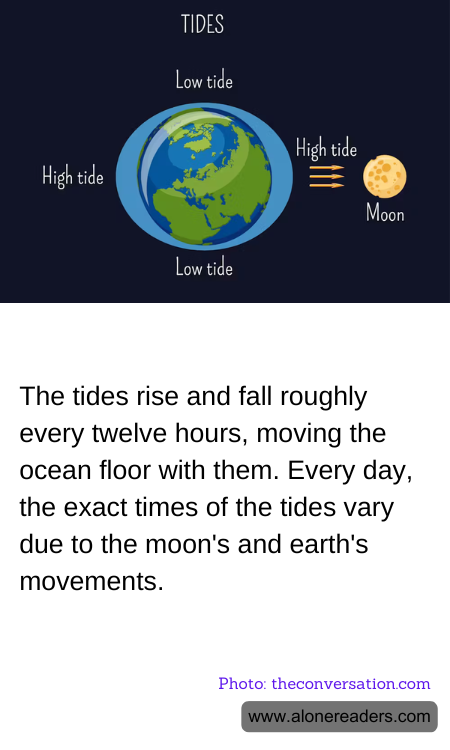
The rhythmic dance of the tides is one of nature's most fascinating phenomena, captivating observers with its predictable yet ever-changing patterns. Approximately every twelve hours, the tides rise and fall, a cycle that has intrigued humans for centuries. This natural occurrence is primarily driven by the gravitational forces exerted by the moon and the sun, as well as the rotation of the Earth.
The moon plays a pivotal role in the tidal movements. As it orbits our planet, its gravitational pull causes the water in the oceans to bulge out in the direction of the moon. This bulge creates what we know as high tide. On the opposite side of the Earth, another high tide occurs due to the centrifugal force created by the Earth's rotation. Between these two high tides, low tides occur. This cycle of high and low tides repeats approximately every 12 hours and 25 minutes, slightly longer than the Earth's rotation period, due to the moon's orbit around the Earth.
However, the exact timing of the tides is not constant and varies daily. This variation is due to the moon's elliptical orbit and its changing position relative to the Earth and the sun. As the moon moves in its orbit, the times of high and low tides shift, typically advancing by about 50 minutes each day. Additionally, the sun's gravitational pull also affects the tides, though to a lesser extent than the moon. When the sun, moon, and Earth align during full and new moons, the combined gravitational forces result in higher high tides and lower low tides, known as spring tides. Conversely, when the sun and moon are at right angles relative to the Earth, the gravitational forces counteract each other, leading to neap tides, which are less extreme.
The movement of the tides is not only a mesmerizing natural spectacle but also has significant implications for the environment and human activities. Tidal movements contribute to the mixing of ocean waters, which helps distribute nutrients and support marine life. For coastal communities, understanding tidal patterns is crucial for navigation, fishing, and managing coastal infrastructure. The rise and fall of tides can also influence weather patterns and coastal erosion, highlighting the interconnectedness of Earth's systems.
In essence, the tides are a testament to the intricate balance of celestial forces and the dynamic nature of our planet. They remind us of the moon's silent yet powerful influence over the Earth, a relationship that has persisted for millennia. As we continue to study and appreciate the tides, we gain a deeper understanding of the natural world and our place within it. Whether you are a scientist, a sailor, or simply a beachgoer, the tides offer a timeless connection to the rhythms of the universe.