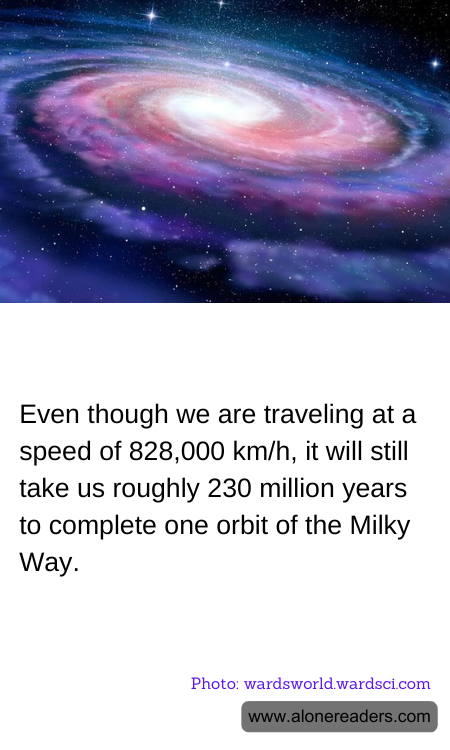
More About This Card
As we gaze up at the night sky, it's easy to forget that our planet, along with the entire solar system, is on an incredible journey through the cosmos. The Earth is not just spinning on its axis or orbiting the Sun; it is also part of a much grander voyage around the center of our galaxy, the Milky Way. This journey is a testament to the vastness of space and the incredible speeds at which celestial bodies move.
Our solar system is hurtling through space at an astonishing speed of approximately 828,000 kilometers per hour. To put this into perspective, this is about 230 times faster than a commercial jetliner. Despite this mind-boggling speed, the sheer size of the Milky Way means that completing a single orbit around its center is a task that requires patience on a cosmic scale. It will take us roughly 230 million years to make one complete orbit, a period known as a "galactic year" or "cosmic year."
The Milky Way is a barred spiral galaxy, a vast collection of stars, gas, and dust bound together by gravity. It is estimated to contain between 100 billion and 400 billion stars, and our solar system is located in one of its spiral arms, known as the Orion Arm. The center of the Milky Way is about 27,000 light-years away from us, and it is home to a supermassive black hole, which exerts a powerful gravitational pull, keeping the galaxy's stars in orbit.
The concept of a galactic year is a humbling reminder of the immense scales involved in our universe. While human history spans only a few thousand years, and the age of the Earth is about 4.5 billion years, a single orbit of the Milky Way dwarfs these timescales. During one galactic year, continents drift, species evolve, and entire civilizations rise and fall. It is a timescale that challenges our understanding of time and our place in the universe.
This journey around the Milky Way is not just a scientific curiosity; it also has profound implications for life on Earth. As our solar system travels through different regions of the galaxy, it encounters varying conditions that can influence the climate and environment on our planet. Some scientists speculate that these galactic movements may have played a role in mass extinctions and evolutionary changes throughout Earth's history.
In contemplating our journey through the Milky Way, we are reminded of the interconnectedness of all things in the universe. Our planet is a small part of a vast cosmic dance, moving in harmony with countless other celestial bodies. This perspective invites us to appreciate the beauty and complexity of the cosmos and to reflect on our place within it. As we continue our orbit around the galaxy, we are part of a story that spans millions of years, a story that is still being written in the stars.