More About This Card
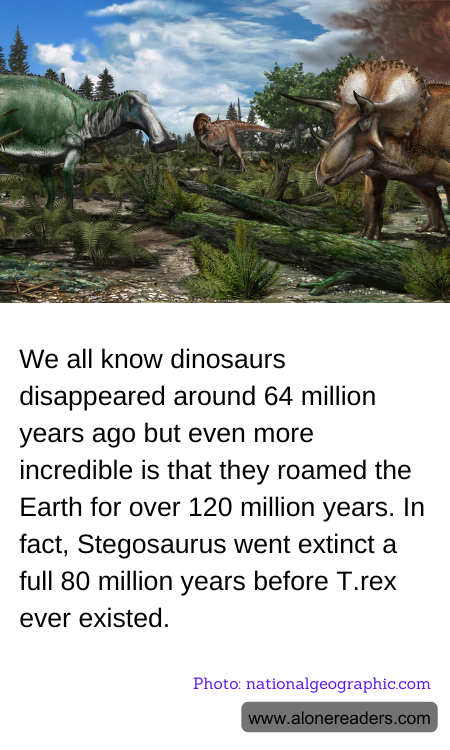
Dinosaurs have long captured the imagination of people of all ages, from young children marveling at their size and ferocity to scientists piecing together the mysteries of their existence. While it is widely known that these magnificent creatures disappeared around 64 million years ago, what is perhaps even more astounding is the sheer length of time they dominated the Earth. Dinosaurs roamed our planet for over 120 million years, a testament to their adaptability and resilience in a world that was constantly changing.
The timeline of dinosaur existence is a fascinating journey through Earth's history. The Mesozoic Era, often referred to as the "Age of Dinosaurs," is divided into three periods: the Triassic, Jurassic, and Cretaceous. Each period saw the rise and fall of different dinosaur species, each uniquely adapted to their environments. Among these, the Stegosaurus and the Tyrannosaurus rex are two of the most iconic, yet they never coexisted. In fact, the Stegosaurus went extinct a full 80 million years before the T. rex ever walked the Earth.
The Stegosaurus, with its distinctive bony plates and spiked tail, lived during the late Jurassic period, approximately 155 to 150 million years ago. This herbivorous dinosaur was well-suited to its environment, using its plates possibly for thermoregulation or display, and its tail spikes, known as the "thagomizer," for defense against predators. Despite its formidable appearance, the Stegosaurus eventually disappeared, likely due to changes in climate and vegetation that it could not adapt to.
Fast forward to the late Cretaceous period, about 68 to 66 million years ago, and the stage is set for the arrival of the Tyrannosaurus rex. Known for its massive size, powerful jaws, and keen senses, the T. rex was one of the last and most formidable of the dinosaur species. Its reign, however, was relatively short-lived. The mass extinction event that occurred around 64 million years ago, likely caused by a massive asteroid impact, brought an abrupt end to the age of dinosaurs, wiping out nearly 75% of Earth's species.
The fact that dinosaurs like the Stegosaurus and T. rex existed millions of years apart highlights the incredible diversity and evolutionary success of these creatures. It also serves as a reminder of the ever-changing nature of life on Earth. While dinosaurs no longer roam the planet, their legacy lives on, not only in the fossils they left behind but also in the birds that are their modern descendants.
Understanding the timeline of dinosaur existence provides valuable insights into the history of our planet and the forces that shape life. It encourages us to appreciate the complexity of evolution and the delicate balance of ecosystems. As we continue to study these ancient giants, we gain a deeper appreciation for the natural world and our place within it.