More About This Card
In the vast expanse of the universe, where mysteries abound and celestial wonders captivate our imagination, pulsars stand out as some of the most intriguing cosmic phenomena. These fascinating objects are a type of neutron star, the remnants of massive stars that have undergone supernova explosions. What makes pulsars particularly captivating is their ability to emit beams of radiation that sweep across the cosmos like the beams of a lighthouse, guiding astronomers in their quest to understand the universe.
Pulsars are incredibly dense, with a mass greater than that of our Sun compressed into a sphere only about 20 kilometers in diameter. This immense density results in a gravitational field so strong that it warps the space around them. The formation of a pulsar begins when a massive star exhausts its nuclear fuel and collapses under its own gravity. The core of the star is compressed to such an extent that protons and electrons merge to form neutrons, resulting in a neutron star. If the neutron star has a strong magnetic field and is rotating rapidly, it becomes a pulsar.
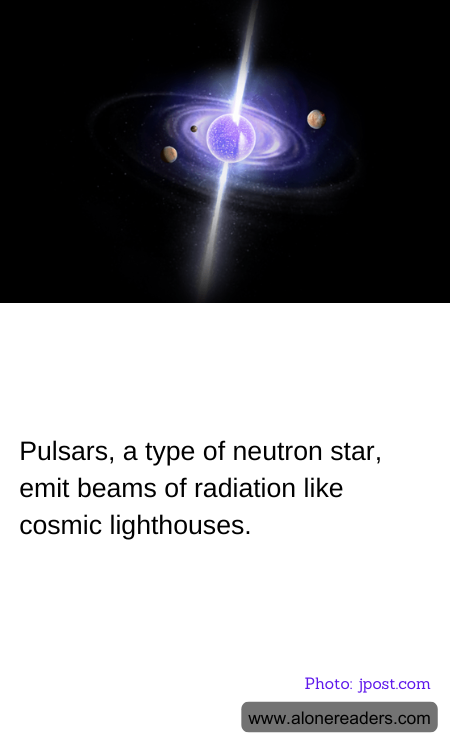
The defining characteristic of pulsars is their emission of beams of electromagnetic radiation, which can include radio waves, X-rays, and even gamma rays. These beams are emitted from the magnetic poles of the pulsar, which are not aligned with its rotational axis. As the pulsar spins, these beams sweep across space, much like the rotating beam of a lighthouse. When one of these beams points toward Earth, it can be detected by radio telescopes as a regular pulse of radiation, hence the name "pulsar."
The regularity of these pulses is astonishing, with some pulsars rotating hundreds of times per second. This precision makes pulsars excellent cosmic clocks, allowing scientists to study a variety of phenomena, from the behavior of matter under extreme conditions to the detection of gravitational waves. Pulsars have even been used to test the general theory of relativity and to map the galaxy.
Despite their small size, pulsars have a profound impact on our understanding of the universe. They serve as natural laboratories for studying the laws of physics in environments that cannot be replicated on Earth. The study of pulsars has led to numerous discoveries, including the first indirect evidence of gravitational waves, which earned the Nobel Prize in Physics in 1993.
Pulsars continue to be a source of fascination and discovery for astronomers and astrophysicists. As we peer deeper into the cosmos, these cosmic lighthouses guide us, illuminating the mysteries of the universe and expanding our understanding of the fundamental forces that govern it. Whether you are a seasoned astronomer or a curious stargazer, the study of pulsars offers a glimpse into the awe-inspiring complexity and beauty of the universe.