More About This Card
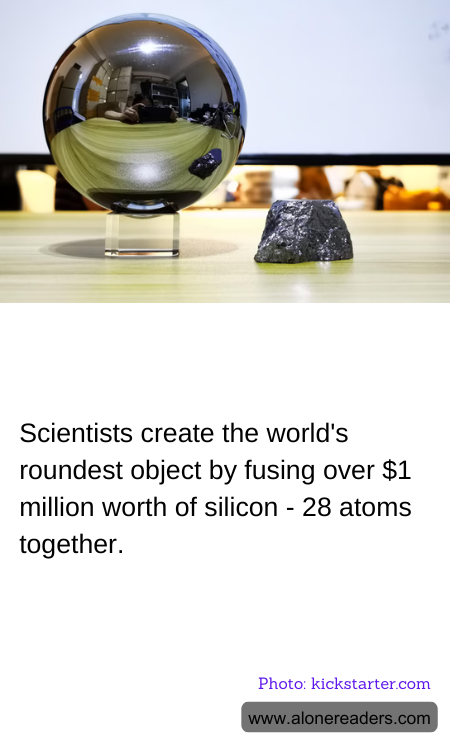
In a groundbreaking achievement that has captured the attention of the scientific community and the public alike, scientists have successfully created the world's roundest object. This remarkable feat was accomplished by fusing over $1 million worth of silicon-28 atoms together, resulting in a sphere of unprecedented precision and uniformity. The creation of this object is not just a testament to human ingenuity but also a significant step forward in the field of metrology, the science of measurement.
The pursuit of perfect roundness is not merely an academic exercise. It has profound implications for the way we measure and understand the world around us. The sphere, crafted from silicon-28, is a marvel of engineering and science. Silicon-28 is a stable isotope of silicon, chosen for its purity and uniformity. By using this specific isotope, scientists were able to minimize imperfections and achieve a level of roundness that was previously thought impossible. The sphere's deviation from a perfect sphere is less than 50 nanometers, which is less than the width of a human hair.
The creation of this object was driven by the need to redefine the kilogram, the base unit of mass in the International System of Units (SI). Traditionally, the kilogram has been defined by a physical object—a platinum-iridium alloy cylinder stored in France. However, this definition is subject to change over time due to surface contamination and other factors. By creating a sphere of silicon-28 with such precision, scientists aim to establish a more stable and reliable standard for the kilogram based on fundamental physical constants.
The process of creating the world's roundest object was a meticulous and labor-intensive endeavor. It involved the collaboration of scientists and engineers from around the globe, each contributing their expertise to overcome the numerous challenges presented by this ambitious project. The silicon-28 atoms were painstakingly arranged and fused together, and the resulting sphere was polished to perfection using advanced techniques that pushed the boundaries of current technology.
Beyond its immediate applications in redefining the kilogram, the creation of this sphere has broader implications for science and technology. It serves as a powerful reminder of the importance of precision and accuracy in scientific research and highlights the potential for future advancements in fields such as nanotechnology and materials science. The sphere also stands as a symbol of international collaboration, demonstrating what can be achieved when experts from different disciplines and countries work together towards a common goal.
In conclusion, the creation of the world's roundest object is a monumental achievement that underscores the importance of precision in science. By fusing over $1 million worth of silicon-28 atoms into a near-perfect sphere, scientists have not only advanced the field of metrology but also set a new standard for what is possible in the realm of scientific exploration. This achievement will undoubtedly inspire future generations of scientists and engineers to continue pushing the boundaries of what we can measure and understand about our universe.