More About This Card
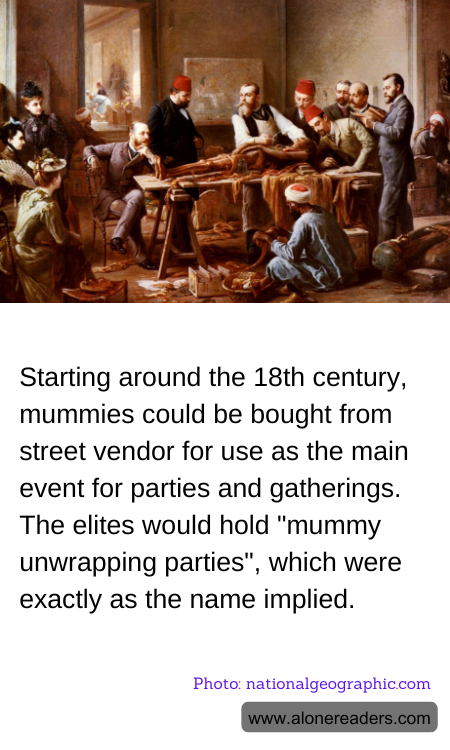
In the annals of history, few practices are as peculiar and intriguing as the mummy unwrapping parties that emerged in the 18th and 19th centuries. During this period, mummies, once revered as sacred relics of ancient Egypt, became the centerpiece of a curious social phenomenon among the European elite. These gatherings, often hosted by affluent individuals, transformed the solemnity of ancient funerary practices into a form of entertainment, reflecting both the era's fascination with Egyptology and its often cavalier attitude towards cultural artifacts.
The fascination with mummies began in earnest during the Napoleonic campaigns in Egypt, which sparked a wave of Egyptomania across Europe. As interest in all things Egyptian grew, so did the demand for mummies. Street vendors in cities like London and Paris began selling mummies, which were often procured through dubious means, to satisfy the curiosity of the wealthy. These mummies, once the carefully preserved remains of ancient Egyptians, were transported far from their resting places to become the main attraction at social gatherings.
At these mummy unwrapping parties, guests would gather in opulent drawing rooms, eager to witness the unveiling of the ancient remains. The host, often an amateur scientist or a collector of antiquities, would carefully remove the linen wrappings, layer by layer, revealing the mummified body beneath. This process, while morbid by modern standards, was seen as a thrilling spectacle, combining elements of science, history, and the macabre. Attendees, dressed in their finest attire, would watch in awe, discussing the mysteries of ancient Egypt and the secrets that might be hidden within the wrappings.
While these events were undoubtedly popular, they also sparked controversy and criticism. Many scholars and cultural commentators of the time decried the practice as disrespectful and unethical. The unwrapping of mummies, they argued, was a violation of the sanctity of the dead and an affront to the cultural heritage of Egypt. Despite these objections, the allure of the mummy unwrapping parties persisted, fueled by a combination of scientific curiosity and a desire for novel entertainment.
Today, the idea of hosting a mummy unwrapping party seems both bizarre and inappropriate. Modern sensibilities have shifted towards a greater respect for cultural artifacts and the preservation of historical heritage. Museums and archaeologists now focus on studying mummies with advanced technology, ensuring that these ancient individuals are treated with the dignity they deserve. The mummy unwrapping parties of the past serve as a reminder of how cultural attitudes can change over time, highlighting the importance of respecting and preserving the legacies of ancient civilizations.