More About This Card
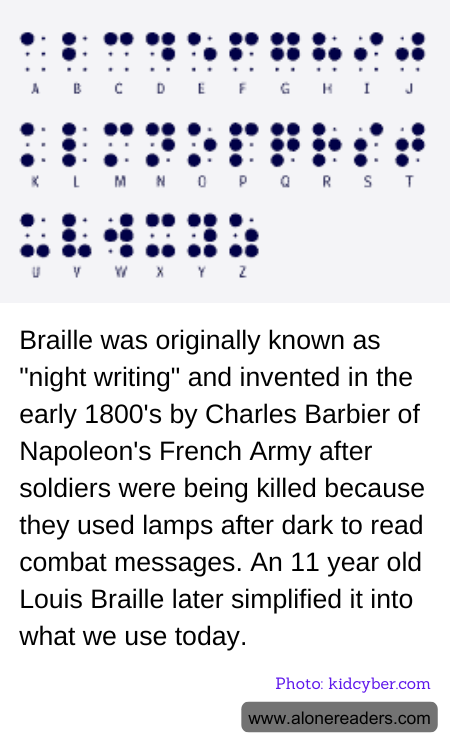
In the early 19th century, a unique system of communication was devised to address a critical problem faced by soldiers in Napoleon's French Army. The need for stealth during nighttime operations was paramount, yet soldiers were often forced to use lamps to read combat messages, inadvertently revealing their positions to the enemy. To solve this, Charles Barbier, an officer in the French Army, invented a tactile system known as "night writing." This system allowed soldiers to read messages by touch, eliminating the need for light and thereby enhancing their safety.
Barbier's system, however, was complex and cumbersome. It consisted of a series of raised dots and dashes that represented phonetic sounds rather than letters, making it difficult to learn and use efficiently. Despite its innovative approach, "night writing" was not widely adopted by the military. Nevertheless, its potential for non-visual communication did not go unnoticed.
Enter Louis Braille, an 11-year-old student at the Royal Institute for Blind Youth in Paris. Braille, who had lost his sight due to a childhood accident, was introduced to Barbier's system and immediately recognized its potential. Driven by a desire to improve the lives of the visually impaired, Braille set out to refine and simplify the system. By 1824, at the tender age of 15, he had developed a new code that was both easier to learn and more efficient to use.
Louis Braille's system reduced the complexity of Barbier's original design by using a six-dot cell to represent each letter of the alphabet, as well as punctuation and numbers. This simplification allowed for a more intuitive and versatile method of reading and writing by touch. Braille's system was revolutionary, providing the visually impaired with unprecedented access to literacy and education.
Despite its effectiveness, Braille's system was not immediately embraced. It took several decades for it to gain widespread acceptance, but eventually, it became the standard for tactile reading and writing worldwide. Today, Braille is an essential tool for millions of people with visual impairments, enabling them to engage with written content independently and confidently.
The story of Braille is a testament to the power of innovation and perseverance. From its origins as a military tool designed to save lives, it evolved into a transformative means of communication for the visually impaired. Louis Braille's legacy continues to impact countless lives, proving that even the simplest ideas can lead to profound change.