More About This Card
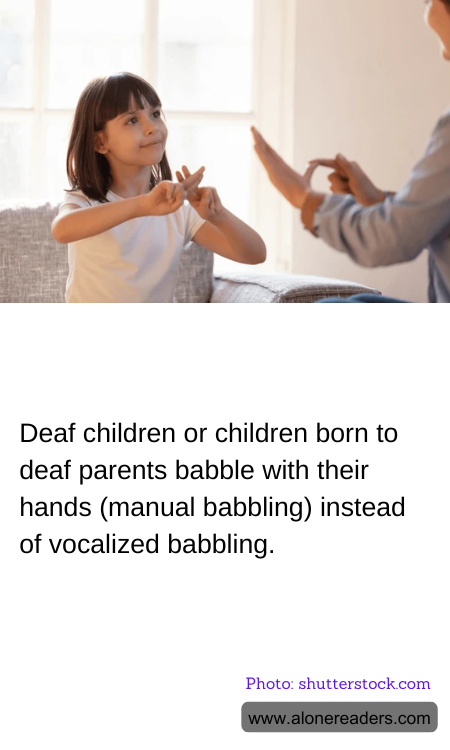
Babbling is a fascinating stage in early childhood development, typically characterized by the repetitive sounds and syllables that infants produce as they begin to explore language. While most people are familiar with vocalized babbling, a lesser-known but equally intriguing phenomenon occurs among deaf children or children born to deaf parents: manual babbling. This form of babbling involves the use of hand movements and gestures, reflecting the natural inclination of these children to communicate through sign language.
Manual babbling is a testament to the adaptability and resilience of human communication. Just as hearing infants experiment with sounds, deaf infants engage in rhythmic and repetitive hand movements that resemble the structure of sign language. These gestures are not random; they are systematic and share similarities with the signs used in American Sign Language (ASL) or other sign languages. This indicates that manual babbling is not merely a mimicry of adult sign language but a natural part of language acquisition for these children.
Research has shown that manual babbling follows a developmental trajectory similar to vocal babbling. It begins with simple, repetitive movements and gradually becomes more complex as the child gains control over their motor skills. This progression mirrors the way hearing infants move from simple cooing to more sophisticated babbling. The presence of manual babbling underscores the idea that the drive to communicate is innate, and the modality—whether vocal or manual—adapts to the child's environment and sensory experiences.
For children born to deaf parents, manual babbling serves as an essential bridge to language acquisition. These children are often exposed to sign language from birth, and their early manual babbling provides a foundation for learning the nuances of sign language. It allows them to practice the rhythm, timing, and structure of signs, much like how vocal babbling helps hearing children master the sounds and patterns of spoken language.
The phenomenon of manual babbling highlights the importance of early exposure to language, regardless of its form. It emphasizes that language development is a universal process, deeply rooted in the human capacity for communication. For parents and caregivers of deaf children, recognizing and encouraging manual babbling can be a crucial step in fostering language development and ensuring that these children have the tools they need to express themselves and connect with the world around them.
In a broader sense, manual babbling challenges traditional notions of language and communication, inviting us to appreciate the diverse ways in which humans express themselves. It serves as a reminder that language is not solely about spoken words but encompasses a rich tapestry of gestures, signs, and symbols that are equally valid and vital in the tapestry of human interaction.