More About This Card
At first glance, the crystals of sea salt and sugar may appear remarkably similar, both presenting as small, white, and glistening granules. However, beneath this superficial resemblance lies a fascinating world of structural differences that set these two common household substances apart. These differences not only influence their physical properties but also their applications in culinary and scientific contexts.
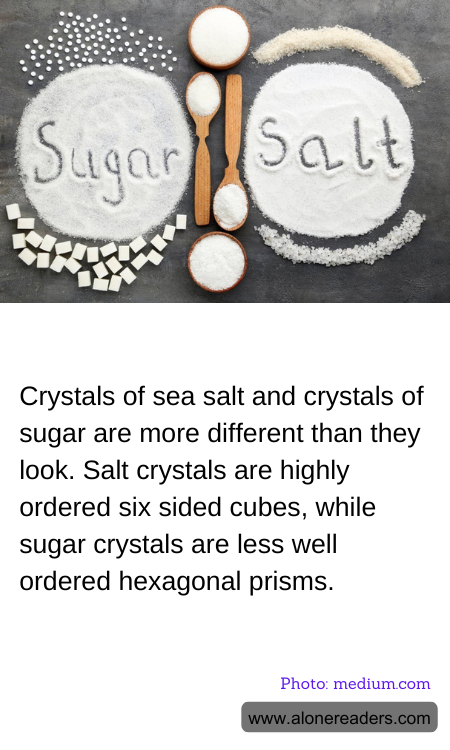
Sea salt, primarily composed of sodium chloride, forms crystals that are highly ordered and exhibit a distinct cubic shape. This geometric precision is a result of the ionic bonds between sodium and chloride ions, which arrange themselves in a repeating pattern that extends in all directions. The six-sided cubes of salt crystals are a testament to this orderly arrangement, reflecting the inherent stability and strength of ionic bonding. This structural integrity is one reason why salt is so effective in preserving food, as the tightly packed ions create a hostile environment for bacteria and other microorganisms.
In contrast, sugar crystals, which are primarily composed of sucrose, exhibit a less ordered structure. These crystals form hexagonal prisms, a shape that arises from the molecular structure of sucrose itself. Unlike the ionic bonds in salt, the bonds in sugar are covalent, involving the sharing of electrons between atoms. This results in a more complex and less uniform arrangement, as the molecules stack together in a way that is not as rigidly defined as the cubic lattice of salt. The hexagonal prisms of sugar crystals reflect this complexity, with their elongated shapes and varied angles.
The differences in crystal structure between salt and sugar have practical implications. For instance, the solubility of these substances in water is influenced by their crystalline forms. Salt, with its tightly packed cubic structure, dissolves readily as the ionic bonds are easily disrupted by water molecules. Sugar, on the other hand, dissolves more slowly due to its larger, more complex crystals, which require more time and energy to break apart.
Moreover, these structural differences also affect how salt and sugar interact with other ingredients in cooking and baking. Salt's ability to dissolve quickly and evenly makes it an ideal seasoning, enhancing flavors without altering the texture of a dish. Sugar's slower dissolution can be advantageous in baking, where its gradual melting contributes to the texture and moisture of cakes and pastries.
In summary, while sea salt and sugar may look alike at a glance, their crystal structures reveal a world of difference. The highly ordered cubic crystals of salt contrast sharply with the less ordered hexagonal prisms of sugar, each reflecting the unique chemical bonds that define them. Understanding these differences not only enriches our appreciation of these everyday substances but also enhances our ability to use them effectively in various applications.