More About This Card
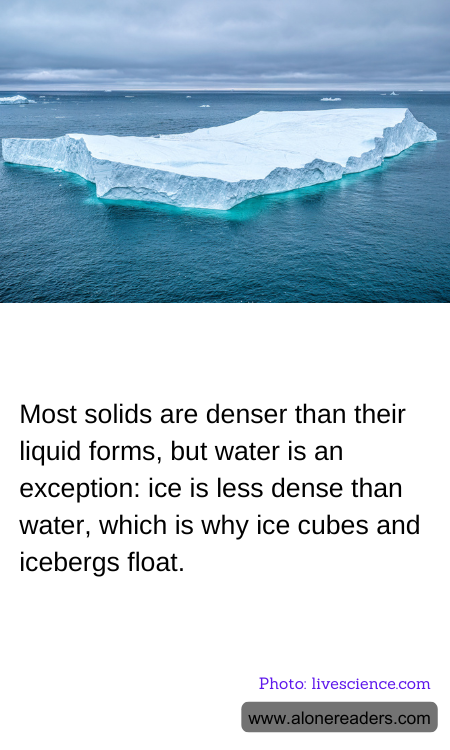
In the fascinating world of chemistry and physics, the behavior of water stands out as a remarkable anomaly. Most substances are denser in their solid state than in their liquid form. This is why a solid piece of metal, for example, will sink in its molten form. However, water defies this norm, exhibiting a unique property where its solid form, ice, is less dense than its liquid state. This peculiar characteristic is the reason why ice cubes float in a glass of water and why massive icebergs drift on the ocean's surface.
The explanation for this unusual behavior lies in the molecular structure of water. Water molecules are composed of two hydrogen atoms bonded to one oxygen atom, forming a V-shaped structure. In its liquid state, water molecules are constantly moving and are packed relatively closely together. However, as water cools and begins to freeze, the molecules arrange themselves into a crystalline structure that is more open and spacious. This hexagonal lattice is maintained by hydrogen bonds, which hold the molecules at a fixed distance from each other, creating a structure that takes up more space than when the molecules are in a liquid state.
This open lattice structure of ice results in a lower density compared to liquid water. Density is defined as mass per unit volume, and because ice occupies more volume for the same amount of mass, it is less dense. Consequently, ice floats on water. This phenomenon has profound implications for life on Earth. If ice were denser than water, it would sink, leading to the freezing of entire bodies of water from the bottom up, which would have devastating effects on aquatic life and the global climate.
The floating of ice is not just a curious scientific fact but a crucial aspect of Earth's environmental balance. Icebergs, which are essentially large chunks of freshwater ice that have broken off from glaciers or ice shelves, float in the ocean due to this same principle. The floating ice acts as an insulator, protecting the water beneath from the cold air above, which helps to regulate the temperature of the ocean and the atmosphere.
Moreover, the floating ice provides a habitat for a variety of wildlife, including polar bears, seals, and penguins, which rely on the ice for hunting, breeding, and resting. The presence of ice in polar regions also plays a critical role in reflecting sunlight, helping to moderate the planet's temperature by maintaining the Earth's energy balance.
In conclusion, the fact that ice is less dense than water is not just a scientific curiosity but a vital feature of our planet's ecosystem. It underscores the intricate and delicate balance of natural processes that sustain life on Earth. Understanding these processes not only enriches our knowledge of the natural world but also highlights the importance of preserving the delicate environmental conditions that allow such phenomena to occur.