More About This Card
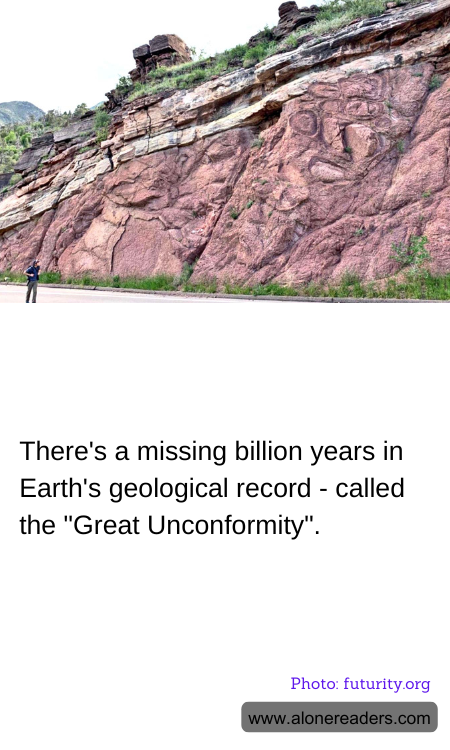
The Earth's geological record is a vast and intricate tapestry that tells the story of our planet's 4.5 billion-year history. However, this record is not without its mysteries. One of the most intriguing is the "Great Unconformity," a significant gap in the geological timeline that spans up to a billion years. This missing chapter has puzzled scientists for decades, as it represents a period where rock layers that should exist simply do not.
The Great Unconformity is evident in various locations around the world, where older rocks are directly overlain by much younger ones, with no intermediate layers to account for the time in between. This gap is most famously observed in the Grand Canyon, where rocks from the Cambrian period, about 540 million years ago, rest directly atop much older Precambrian rocks, which are over a billion years old. The absence of rock layers from this intervening period suggests that significant geological processes were at play, erasing a substantial portion of Earth's history.
Several theories have been proposed to explain this enigmatic gap. One leading hypothesis suggests that the Great Unconformity resulted from a period of intense erosion. During this time, vast amounts of rock could have been worn away by natural forces such as wind, water, and ice, effectively erasing the geological record of that era. Another theory posits that tectonic activity, such as the formation and breakup of supercontinents, could have played a role in the disappearance of these rock layers. These massive geological shifts could have caused the uplift and subsequent erosion of large landmasses, contributing to the unconformity.
Recent studies have also explored the possibility that the Great Unconformity is linked to the Snowball Earth hypothesis, which suggests that the planet underwent a series of global glaciations during the Precambrian era. These ice ages could have contributed to the erosion and removal of rock layers, as glaciers advanced and retreated across the continents. The immense pressure and movement of ice could have scraped away vast amounts of material, leaving behind the unconformity we observe today.
Despite these theories, the Great Unconformity remains a topic of active research and debate within the scientific community. Understanding this missing billion years is crucial, as it could provide insights into the Earth's early climate, the evolution of life, and the processes that have shaped our planet over time. As scientists continue to investigate this geological mystery, they employ advanced techniques such as radiometric dating and computer modeling to piece together the events that led to this significant gap in the Earth's history.
The Great Unconformity serves as a reminder of the dynamic and ever-changing nature of our planet. While much of Earth's history is preserved in the rocks beneath our feet, there are still many secrets waiting to be uncovered. As researchers delve deeper into this geological enigma, they bring us closer to understanding the complex and fascinating story of our planet's past.