More About This Card
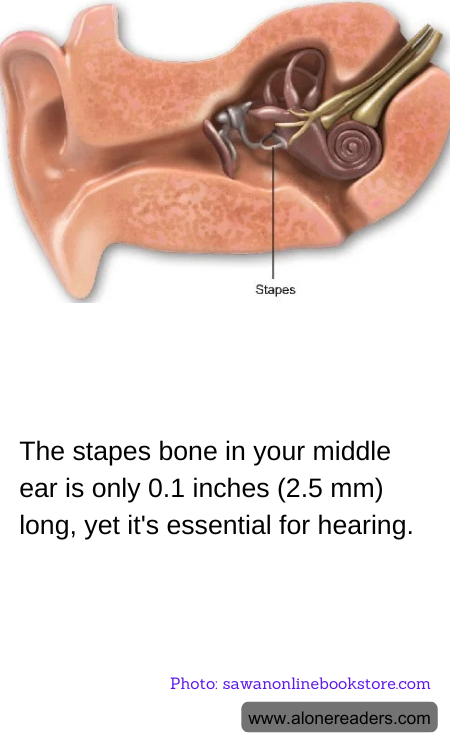
In the intricate world of human anatomy, the stapes bone stands out as a marvel of nature's engineering. Despite its diminutive size, measuring only about 0.1 inches or 2.5 millimeters in length, the stapes plays a crucial role in our ability to hear. Nestled within the middle ear, this tiny bone is part of a trio known as the ossicles, which also includes the malleus and incus. Together, these bones form a critical link in the auditory chain, transforming sound waves into signals that our brains can interpret.
The stapes is often referred to as the "stirrup" due to its distinctive shape, which resembles the stirrup of a saddle. This shape is not just a biological curiosity; it is essential for its function. The stapes connects to the oval window, a membrane-covered opening to the inner ear. When sound waves enter the ear, they cause the eardrum to vibrate. These vibrations are then transmitted through the ossicles, with the stapes acting as the final conduit, amplifying and transferring the vibrations to the fluid-filled cochlea in the inner ear.
The efficiency of the stapes is remarkable. Despite its small size, it is capable of amplifying sound vibrations by about 20 times before they reach the inner ear. This amplification is crucial for our ability to hear a wide range of sounds, from the softest whisper to the loudest shout. Without the stapes, or if it were to malfunction, our hearing would be significantly impaired, highlighting its indispensable role in the auditory process.
The importance of the stapes is further underscored by its evolutionary history. It is one of the oldest bones in the human body, with its origins tracing back to the early vertebrates. Over millions of years, the stapes has evolved to become perfectly adapted to its role in hearing, a testament to the intricate and precise nature of evolutionary processes.
In medical science, the stapes is often a focus of study, particularly in conditions such as otosclerosis, where abnormal bone growth can lead to hearing loss. Advances in medical technology have made it possible to replace or repair a malfunctioning stapes, restoring hearing to those affected by such conditions. This underscores the bone's significance and the lengths to which science will go to preserve its function.
In conclusion, the stapes bone, though small, is a giant in its contribution to our sensory experience. Its ability to amplify and transmit sound is a cornerstone of our auditory system, allowing us to engage with the world through the rich tapestry of sound. As we continue to explore the complexities of the human body, the stapes remains a symbol of how even the smallest components can have an outsized impact on our lives.