More About This Card
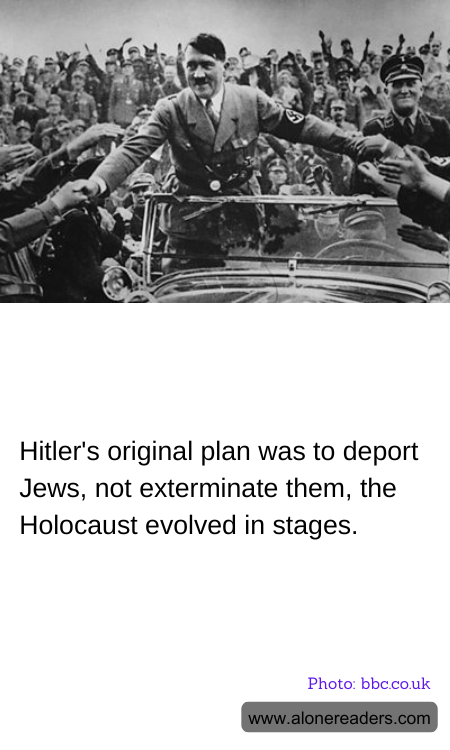
Adolf Hitler's rise to power in Germany marked the beginning of one of the darkest chapters in human history. The Holocaust, which resulted in the systematic extermination of six million Jews, is often viewed as a singular, horrific event. However, historical evidence suggests that the path to genocide was not initially set in stone. Hitler's original plan was not to exterminate the Jews but to deport them, and the Holocaust evolved in stages over time.
In the early years of Nazi rule, the regime's anti-Semitic policies focused on marginalizing and isolating Jews from German society. The Nuremberg Laws of 1935 stripped Jews of their citizenship and barred them from various professions. During this period, the Nazi leadership explored various options for the forced emigration of Jews. One such plan was the Madagascar Plan, which proposed the mass deportation of European Jews to the island of Madagascar. This idea, however, was deemed impractical due to logistical challenges and the outbreak of World War II.
As the war progressed, the Nazis occupied vast territories in Eastern Europe, bringing millions more Jews under their control. The initial strategy of deportation became increasingly unfeasible, and the regime's policies grew more radical. The invasion of the Soviet Union in 1941 marked a turning point. The Einsatzgruppen, mobile killing units, began mass shootings of Jews in occupied territories. This escalation in violence indicated a shift towards more extreme measures.
The Wannsee Conference in January 1942 is often cited as the moment when the "Final Solution" was formalized. High-ranking Nazi officials convened to discuss and coordinate the systematic extermination of the Jewish population. This marked the transition from deportation and sporadic killings to an organized, industrial-scale genocide. Concentration camps were expanded, and extermination camps like Auschwitz, Sobibor, and Treblinka were established to carry out mass murder efficiently.
The evolution of Nazi policy from deportation to extermination was not a linear process but rather a series of escalating actions driven by ideological fanaticism, wartime exigencies, and bureaucratic momentum. The shift was influenced by a combination of factors, including the failure of earlier deportation plans, the logistical challenges of war, and the radicalization of Nazi ideology.
Understanding the stages of the Holocaust is crucial for comprehending how such atrocities can occur. It serves as a stark reminder of the dangers of unchecked hatred and the importance of vigilance in preventing future genocides. The Holocaust did not happen overnight; it was the result of a series of decisions and actions that gradually dehumanized and destroyed an entire people. Recognizing this progression is essential in ensuring that history does not repeat itself.