More About This Card
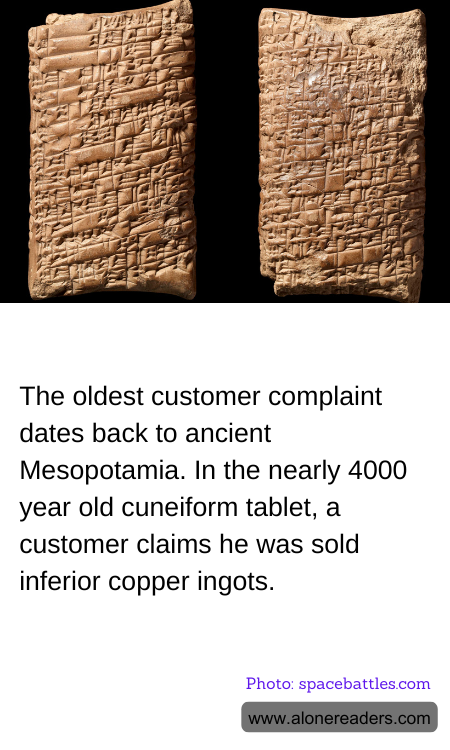
In the annals of history, the concept of customer dissatisfaction is not a modern phenomenon. In fact, the oldest recorded customer complaint dates back nearly 4,000 years to ancient Mesopotamia, a civilization renowned for its pioneering contributions to writing, law, and commerce. This intriguing piece of history is encapsulated in a cuneiform tablet, a clay artifact inscribed with wedge-shaped characters, which reveals the grievances of a disgruntled customer named Nanni.
Nanni's complaint is directed towards a merchant named Ea-nasir, who was based in the city of Ur, a bustling hub of trade and culture in ancient Mesopotamia. The tablet, written in Akkadian, details Nanni's dissatisfaction with a shipment of copper ingots he had purchased. According to the complaint, the copper delivered was of inferior quality compared to what was promised. Nanni's frustration is palpable as he accuses Ea-nasir of not only providing substandard goods but also of treating him with disrespect during a previous visit.
This ancient complaint highlights the complexities of trade and commerce even in early civilizations. It underscores the importance of trust and quality in business transactions, principles that remain relevant in today's global marketplace. The fact that Nanni took the time to document his grievance on a clay tablet suggests that consumer rights and the expectation of fair treatment were valued even in ancient times. It also reflects the sophisticated level of communication and record-keeping that existed in Mesopotamia, where writing was a crucial tool for administration and trade.
The cuneiform tablet serves as a fascinating reminder of the enduring nature of human interactions and the timeless challenges of maintaining customer satisfaction. It provides a glimpse into the daily life of ancient Mesopotamians, revealing that while technology and society have evolved dramatically, the fundamental dynamics of commerce and human behavior have remained remarkably consistent. This ancient complaint not only enriches our understanding of Mesopotamian culture but also connects us to our ancestors, illustrating that the pursuit of fairness and quality in trade is a universal and age-old endeavor.
In a world where customer feedback is now instant and widespread, thanks to digital platforms, Nanni's clay tablet stands as a testament to the long history of consumer advocacy. It reminds us that the voice of the customer has always been a powerful force, driving merchants and businesses to uphold standards and deliver on promises. As we navigate the complexities of modern commerce, the story of Nanni and Ea-nasir serves as both a historical curiosity and a timeless lesson in the importance of integrity and accountability in business.