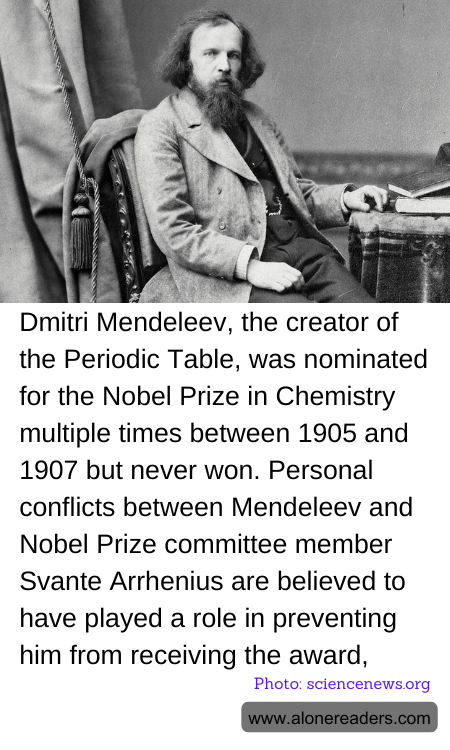
More About This Card
Dmitri Mendeleev, a name synonymous with the periodic table, is celebrated for his groundbreaking work in chemistry. His creation of the periodic table in 1869 revolutionized the way scientists understood chemical elements and their relationships. Despite his monumental contribution to science, Mendeleev never received the Nobel Prize in Chemistry, although he was nominated multiple times between 1905 and 1907. The reasons behind this oversight are as intriguing as the man himself, with personal conflicts playing a significant role.
Mendeleev's periodic table was a masterpiece of scientific insight. By organizing elements based on atomic weight and properties, he not only predicted the existence of undiscovered elements but also corrected the atomic weights of some known ones. This achievement laid the foundation for modern chemistry and earned him widespread acclaim. However, when it came to the Nobel Prize, Mendeleev's path was obstructed by more than just scientific considerations.
One of the key figures in this narrative is Svante Arrhenius, a prominent member of the Nobel Prize committee and a distinguished chemist in his own right. Arrhenius and Mendeleev had a strained relationship, marked by professional disagreements and personal animosity. Arrhenius, known for his work on electrolytic dissociation and the theory of acids and bases, held significant influence over the Nobel committee's decisions. It is widely believed that his personal conflicts with Mendeleev played a crucial role in the latter's repeated exclusion from the Nobel laureates.
The tension between Mendeleev and Arrhenius was not merely a clash of personalities but also a reflection of differing scientific philosophies. Mendeleev was a staunch critic of Arrhenius's theories, particularly his ideas on ionization and electrolytic dissociation. This scientific rivalry, coupled with personal discord, created an environment where Mendeleev's contributions were overshadowed by the politics of the time.
Despite the Nobel committee's oversight, Mendeleev's legacy remains untarnished. His periodic table continues to be a fundamental tool in chemistry education and research, underscoring the timeless nature of his work. While the Nobel Prize eluded him, Mendeleev's impact on science is undeniable and enduring. His story serves as a reminder of the complex interplay between scientific achievement and the human elements that can influence recognition and reward.
In the annals of scientific history, Dmitri Mendeleev stands as a testament to the power of insight and innovation. His experience with the Nobel Prize highlights the challenges that can accompany even the most significant contributions to human knowledge. As we reflect on his legacy, it is clear that Mendeleev's true prize lies in the lasting influence of his work, which continues to inspire and educate generations of scientists around the world.