More About This Card
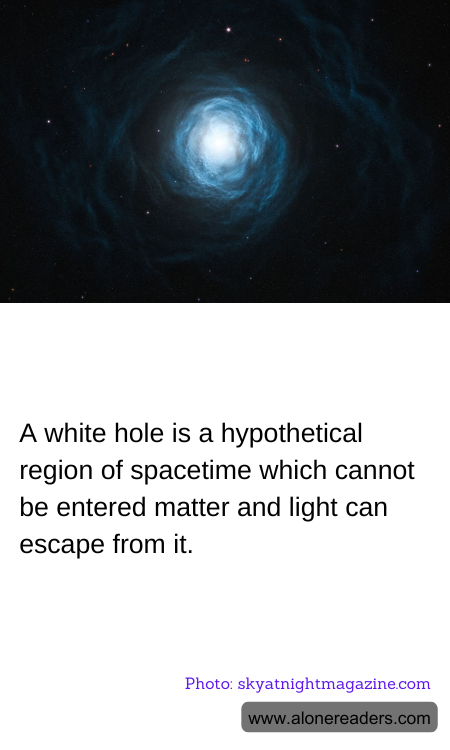
In the vast and mysterious realm of theoretical physics, the concept of a white hole presents an intriguing counterpart to the more familiar black hole. While black holes are known for their intense gravitational pull, from which nothing can escape, white holes are hypothesized to be regions of spacetime that cannot be entered, yet allow matter and light to escape. This fascinating idea challenges our understanding of the universe and invites us to explore the boundaries of scientific imagination.
The notion of a white hole emerges from the solutions to the equations of general relativity, the groundbreaking theory proposed by Albert Einstein. These equations describe how matter and energy influence the curvature of spacetime, leading to the formation of gravitational fields. In this framework, black holes are solutions that result from the collapse of massive stars, creating a singularity surrounded by an event horizon. Beyond this horizon, the gravitational pull is so strong that not even light can escape.
Conversely, a white hole is theorized as the time-reversal of a black hole. While a black hole draws everything inward, a white hole expels matter and light outward, preventing anything from entering its domain. This peculiar behavior suggests that white holes could be the ultimate cosmic fountains, spewing out matter and energy into the universe. However, unlike black holes, which have been observed indirectly through their effects on nearby matter and radiation, white holes remain purely theoretical, with no empirical evidence to support their existence.
The concept of white holes also raises intriguing questions about the nature of time and causality. If white holes exist, they could potentially serve as gateways to other regions of spacetime, perhaps even connecting different universes. This idea aligns with the speculative notion of wormholes, which are hypothetical tunnels through spacetime that could link distant points in the universe. Some theories suggest that a black hole could be connected to a white hole via a wormhole, creating a bridge between different regions of the cosmos.
Despite the allure of these ideas, the existence of white holes remains a topic of debate among physicists. The lack of observational evidence and the challenges posed by their theoretical implications make white holes a subject of ongoing research and speculation. Nonetheless, the exploration of such concepts continues to push the boundaries of our understanding, inspiring new theories and experiments that seek to unravel the mysteries of the universe.
In conclusion, while white holes remain a hypothetical construct within the realm of theoretical physics, they offer a captivating glimpse into the possibilities of our universe. As scientists continue to probe the depths of spacetime, the study of white holes serves as a reminder of the boundless curiosity and imagination that drive the quest for knowledge. Whether or not white holes exist, their exploration enriches our understanding of the cosmos and fuels the ongoing journey to uncover the secrets of the universe.