More About This Card
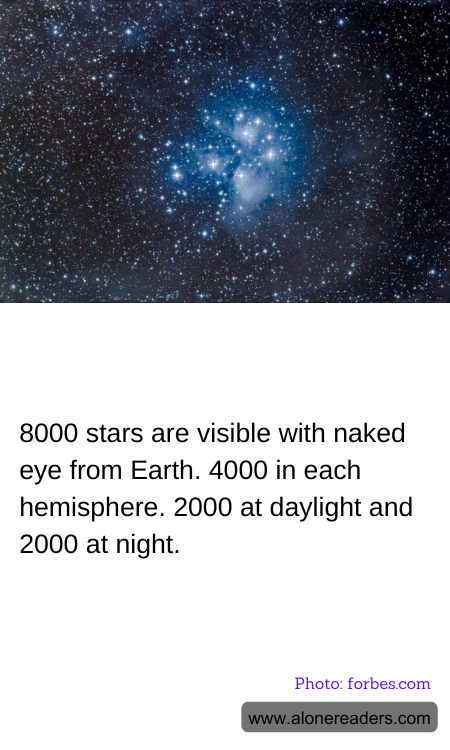
When we gaze up at the night sky, we are often captivated by the twinkling stars that dot the vast expanse above us. It is a humbling experience to realize that, despite the billions of stars in our galaxy, only about 8,000 are visible to the naked eye from Earth. These stars are distributed evenly between the two hemispheres, with approximately 4,000 stars visible in each.
The division of stars between the hemispheres is a result of Earth's position and rotation. As our planet orbits the Sun, different sections of the sky become visible at different times of the year. This celestial dance allows us to witness a variety of constellations and stars, depending on our geographical location and the time of year. In each hemisphere, about 2,000 stars can be seen during the night, while the remaining 2,000 are visible during daylight hours, though they are obscured by the brightness of the Sun.
The stars visible at night have been a source of wonder and inspiration for countless generations. Ancient civilizations used them for navigation, storytelling, and as a means to mark the passage of time. Constellations, the patterns formed by groups of stars, have been named and interpreted in myriad ways across different cultures. These celestial markers continue to hold significance today, as they connect us to our ancestors and the shared human experience of stargazing.
During the day, the stars are still present in the sky, but the Sun's overwhelming brightness makes them invisible to our eyes. This phenomenon is a reminder of the vastness of the universe and the limitations of our perception. The Sun itself is a star, albeit much closer to us than any other, and its light dominates our daytime sky. However, with the aid of telescopes and other instruments, astronomers can study the stars that remain hidden from our view during daylight hours.
The ability to see 8,000 stars with the naked eye is a testament to the natural beauty and complexity of the cosmos. It invites us to ponder our place in the universe and to appreciate the wonders that lie beyond our immediate surroundings. Whether we are stargazing on a clear night or contemplating the unseen stars during the day, the celestial sphere offers a sense of continuity and connection that transcends time and space.
In a world where technology often dominates our attention, taking a moment to look up at the stars can be a grounding experience. It reminds us of the simplicity and grandeur of nature, encouraging us to explore, learn, and dream. As we continue to study the stars and expand our understanding of the universe, we are reminded that there is always more to discover, both in the sky above and within ourselves.