More About This Card
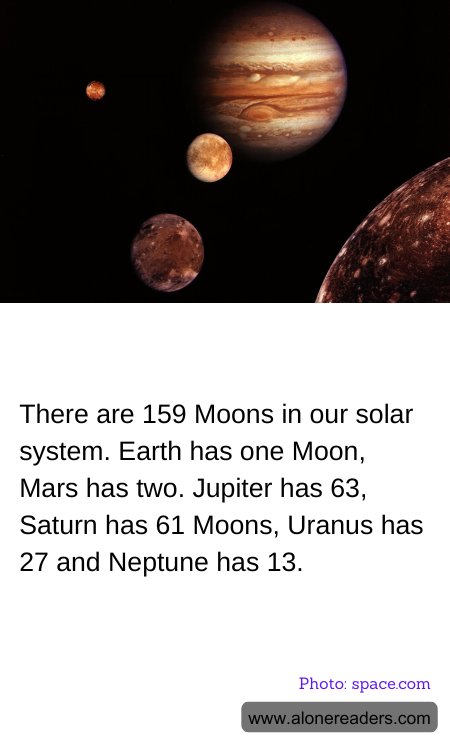
The solar system, a vast and intriguing expanse, is home to a multitude of celestial bodies, including a fascinating array of moons. These natural satellites, orbiting the planets, vary in size, composition, and number, contributing to the dynamic nature of our cosmic neighborhood. In total, there are 159 known moons in our solar system, each with its own unique characteristics and stories to tell.
Earth, our home planet, is accompanied by a single moon, often simply referred to as "the Moon." This celestial companion has been a source of wonder and inspiration for humanity throughout history, influencing tides, calendars, and even cultural lore. Its surface, marked by craters and maria, has been the subject of numerous scientific explorations, including the historic Apollo missions.
Mars, the red planet, hosts two small moons named Phobos and Deimos. These irregularly shaped bodies are thought to be captured asteroids, and their proximity to Mars makes them intriguing targets for future exploration. Despite their diminutive size, Phobos and Deimos offer valuable insights into the history and evolution of the Martian system.
Jupiter, the largest planet in our solar system, boasts an impressive collection of 63 moons. Among them are the four largest, known as the Galilean moons: Io, Europa, Ganymede, and Callisto. Discovered by Galileo Galilei in 1610, these moons are diverse in their characteristics, with Ganymede being the largest moon in the solar system and Europa harboring a subsurface ocean that may hold the potential for life.
Saturn, famous for its stunning rings, is orbited by 61 moons. Titan, the largest of Saturn's moons, is particularly noteworthy due to its dense atmosphere and surface lakes of liquid methane and ethane. This moon, along with others like Enceladus, which exhibits geysers of water ice, continues to captivate scientists with the possibility of harboring life or offering clues about the early solar system.
Uranus, an ice giant, has 27 known moons. These moons are named after characters from the works of William Shakespeare and Alexander Pope, adding a touch of literary charm to their scientific intrigue. The moons of Uranus, such as Miranda and Ariel, display varied geological features, including canyons and ice cliffs, hinting at complex geological histories.
Neptune, the outermost planet in our solar system, is accompanied by 13 moons. Triton, the largest, is unique due to its retrograde orbit, suggesting it may have been captured by Neptune's gravity. Triton's icy surface and geysers make it a subject of great interest for understanding the dynamics of the outer solar system.
The moons of our solar system, with their diverse characteristics and origins, offer a window into the processes that have shaped our cosmic neighborhood. As technology advances and exploration continues, these celestial bodies will undoubtedly reveal more secrets, enriching our understanding of the universe and our place within it.