More About This Card
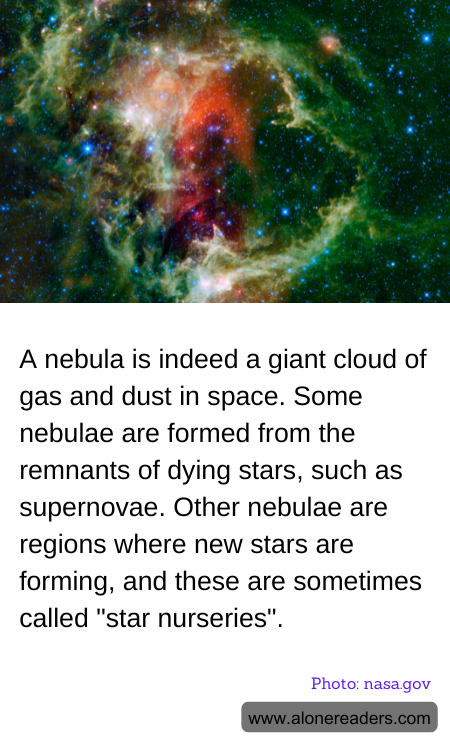
A nebula, a term that evokes images of ethereal beauty and cosmic wonder, is indeed a giant cloud of gas and dust in space. These celestial formations are not only visually stunning but also play a crucial role in the life cycle of stars. Nebulae can be found throughout the universe, each with its own unique characteristics and origins.
Some nebulae are born from the remnants of dying stars. When a massive star reaches the end of its life, it may explode in a spectacular supernova. This explosion disperses the star's outer layers into space, creating a nebula. The Crab Nebula, for example, is the result of a supernova that was observed by Chinese astronomers in 1054 AD. These remnants are rich in elements such as carbon, oxygen, and nitrogen, which are essential for the formation of new stars and planets. The material ejected during a supernova can travel vast distances, eventually coalescing to form new celestial bodies.
In contrast, other nebulae are regions where new stars are forming, often referred to as "star nurseries." These nebulae are dense with gas and dust, providing the perfect environment for star formation. Within these regions, gravity pulls the gas and dust together, causing them to collapse and heat up. As the temperature rises, nuclear fusion ignites, and a new star is born. The Orion Nebula is one of the most famous star nurseries, located about 1,344 light-years away from Earth. It is a bustling region of star formation, with hundreds of young stars in various stages of development.
Nebulae are not only important for star formation but also for enriching the universe with heavy elements. As stars evolve and die, they release these elements into space, contributing to the cosmic cycle of matter. This process ensures that the universe is constantly renewing itself, with new stars and planets forming from the remnants of the old.
For astronomers and space enthusiasts alike, nebulae offer a glimpse into the dynamic processes that shape our universe. They are a testament to the beauty and complexity of the cosmos, reminding us of the interconnectedness of all things. Whether formed from the remnants of dying stars or as cradles for new ones, nebulae are a vital part of the cosmic tapestry, continuing to inspire wonder and curiosity across generations.