More About This Card
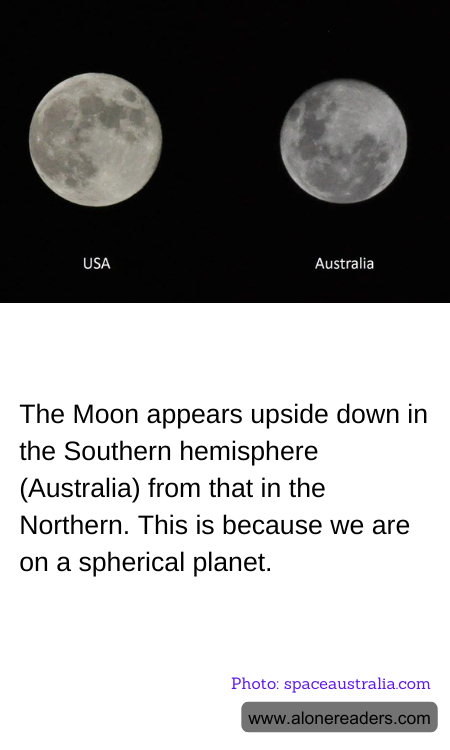
When gazing up at the night sky, many people are captivated by the serene beauty of the Moon. However, travelers who venture from the Northern Hemisphere to the Southern Hemisphere, such as to Australia, often notice something peculiar: the Moon appears to be upside down. This intriguing phenomenon is a direct result of our planet's spherical shape and the way we perceive celestial objects from different vantage points on Earth.
Imagine the Earth as a giant sphere suspended in space. People standing in the Northern Hemisphere are essentially on the "top" half of this sphere, while those in the Southern Hemisphere are on the "bottom" half. When you look at the Moon from the Northern Hemisphere, you are viewing it from a different angle compared to someone in the Southern Hemisphere. This difference in perspective is what causes the Moon to appear inverted.
To better understand this, consider holding a globe in your hands. If you stand above the globe and look down at it, you will see the continents in one orientation. Now, if you flip the globe upside down and look at it from below, the continents will appear inverted. Similarly, when you move from one hemisphere to the other, your viewpoint of the Moon changes, leading to the perception that it is upside down.
This effect is not limited to the Moon. The entire night sky appears differently depending on where you are on Earth. Constellations that are familiar in the Northern Hemisphere, such as the Big Dipper, are not visible in the Southern Hemisphere. Instead, Southern Hemisphere observers enjoy sights like the Southern Cross, which is not visible to those in the north. This diversity in celestial views is one of the many wonders of our planet's geography.
The spherical nature of Earth also means that the Moon rises and sets in different directions depending on your location. In the Northern Hemisphere, the Moon generally rises in the east and sets in the west, moving across the southern part of the sky. In contrast, in the Southern Hemisphere, the Moon follows a path across the northern sky. This shift further contributes to the difference in how the Moon is perceived from various parts of the world.
Understanding why the Moon appears upside down in different hemispheres is a fascinating reminder of the interconnectedness of our planet and the universe. It highlights the importance of perspective and how our position on Earth influences our view of the cosmos. Whether you are in the Northern or Southern Hemisphere, the Moon remains a constant companion in the night sky, offering a unique view to all who take the time to look up and appreciate its beauty.