More About This Card
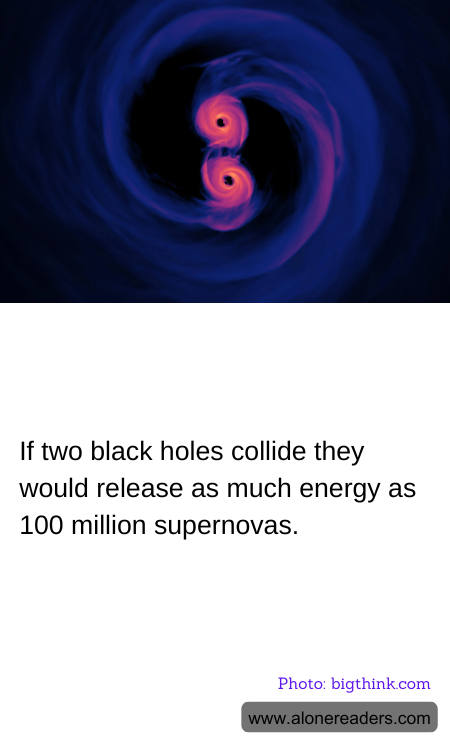
In the vast and mysterious expanse of the universe, few phenomena capture the imagination quite like black holes. These enigmatic cosmic entities, with their immense gravitational pull, have long been subjects of fascination and study. Among the most awe-inspiring events involving black holes is their collision, a cataclysmic occurrence that releases an extraordinary amount of energy, comparable to 100 million supernovas.
A black hole is formed when a massive star exhausts its nuclear fuel and collapses under its own gravity, creating a region in space where the gravitational pull is so strong that nothing, not even light, can escape. When two black holes orbit each other and eventually collide, the event is nothing short of spectacular. As they spiral closer together, they emit gravitational waves—ripples in the fabric of spacetime that were first predicted by Albert Einstein in 1916 and detected a century later by the LIGO observatory.
The collision of black holes is a process that unfolds over millions of years, but the final moments are incredibly swift and violent. As the black holes merge, they release a burst of energy that is staggeringly powerful. To put it into perspective, a single supernova, the explosive death of a star, can outshine an entire galaxy for a brief period. Now, imagine the energy of 100 million supernovas being unleashed in a fraction of a second. This is the magnitude of energy released when two black holes collide.
This immense release of energy is primarily in the form of gravitational waves, which carry information about the black holes' masses, spins, and the nature of their collision. These waves travel across the universe, providing scientists with invaluable data that helps to unravel the mysteries of these cosmic giants. The detection of gravitational waves from black hole collisions has opened a new window into the universe, allowing astronomers to observe events that were previously invisible.
The study of black hole collisions not only enhances our understanding of these fascinating objects but also sheds light on the fundamental laws of physics. It challenges and refines our theories of gravity and the behavior of matter under extreme conditions. Moreover, it offers insights into the formation and evolution of galaxies, as black holes are often found at their centers, influencing their structure and dynamics.
For the general public, the collision of black holes is a reminder of the universe's grandeur and the incredible forces at play beyond our everyday experience. It sparks curiosity and wonder, encouraging people of all ages to explore the mysteries of the cosmos. As we continue to study these extraordinary events, we are reminded of our place in the universe and the boundless possibilities that lie beyond our current understanding.