More About This Card
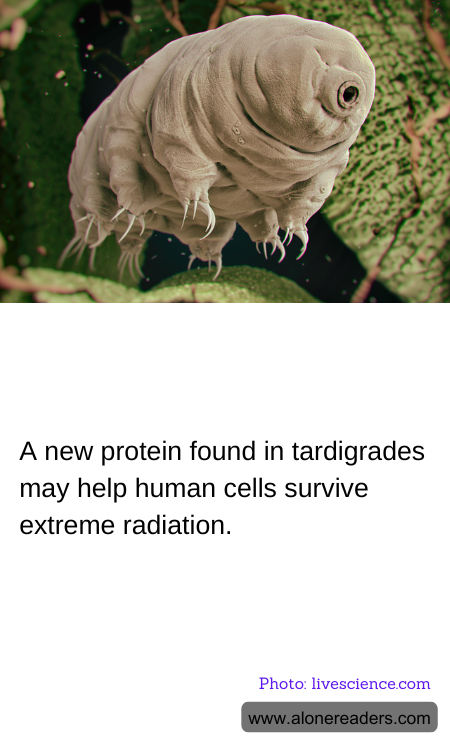
In a groundbreaking discovery, scientists have identified a new protein in tardigrades that could potentially revolutionize our understanding of cellular resilience to extreme radiation. Tardigrades, often referred to as water bears, are microscopic creatures renowned for their ability to survive in some of the harshest environments on Earth, including the vacuum of space and intense radiation levels. This newfound protein, named Dsup (short for Damage suppressor), is believed to play a crucial role in their extraordinary survival capabilities.
The discovery of Dsup has opened up exciting possibilities for enhancing human cell resistance to radiation. Researchers have found that when this protein is introduced into human cells, it significantly reduces DNA damage caused by radiation exposure. This finding is particularly promising for fields such as medicine and space exploration, where radiation poses a significant risk. In medical treatments like radiation therapy, which is used to target cancer cells, the challenge has always been to minimize damage to surrounding healthy tissues. The integration of Dsup into human cells could potentially protect these healthy cells, improving the efficacy and safety of such treatments.
Moreover, the implications of this discovery extend to the realm of space travel. As humanity sets its sights on long-duration missions to Mars and beyond, one of the major hurdles is protecting astronauts from the high levels of cosmic radiation encountered in space. The ability to enhance human cells with Dsup could provide a biological shield, reducing the risk of radiation-induced illnesses and making extended space missions more feasible.
The research into Dsup is still in its early stages, and scientists are working diligently to understand the precise mechanisms by which this protein operates. There are also ethical and safety considerations to address before any practical applications can be realized. However, the potential benefits are immense, and this discovery has sparked a wave of optimism in the scientific community.
This breakthrough underscores the importance of studying extremophiles like tardigrades, which have evolved unique adaptations to survive conditions that would be lethal to most life forms. By unraveling the secrets of these resilient organisms, scientists can develop innovative solutions to some of the most pressing challenges facing humanity today. As research progresses, the hope is that Dsup and similar discoveries will pave the way for new technologies that enhance human resilience, both on Earth and beyond.