More About This Card
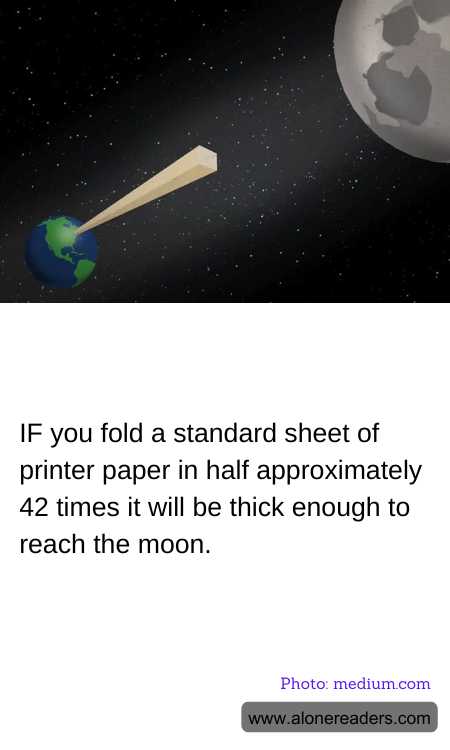
The idea that folding a standard sheet of printer paper 42 times could result in a thickness reaching the moon is a fascinating concept that captures the imagination. At first glance, it seems impossible. After all, a single sheet of paper is only about 0.1 millimeters thick. However, this thought experiment is a perfect illustration of exponential growth, a mathematical principle that can produce astonishing results.
When you fold a piece of paper in half, you double its thickness. The first fold results in a thickness of 0.2 millimeters, the second fold brings it to 0.4 millimeters, and so on. This doubling continues with each fold, leading to an exponential increase in thickness. By the time you reach the 42nd fold, the paper's thickness would theoretically extend beyond 439,804 kilometers, which is more than the average distance from the Earth to the moon, approximately 384,400 kilometers.
This concept is not just a quirky mathematical exercise but also an excellent way to understand the power of exponential growth. It demonstrates how quickly numbers can escalate when they are repeatedly doubled. This principle is not only applicable to paper folding but also to various real-world phenomena, such as population growth, viral spread, and technological advancements.
However, in practice, folding a piece of paper 42 times is impossible with our current materials and methods. The physical limitations of paper, such as its tensile strength and flexibility, make it difficult to fold more than seven or eight times. Each fold requires more force, and the paper becomes increasingly resistant to bending. To achieve 42 folds, you would need a sheet of paper that is extraordinarily large and strong, far beyond the capabilities of standard printer paper.
Despite these practical limitations, the thought experiment serves as a valuable educational tool. It encourages people to think critically about mathematical concepts and their implications. It also highlights the importance of understanding exponential growth, a concept that is crucial in fields ranging from finance to biology.
In conclusion, while folding a piece of paper 42 times to reach the moon remains a theoretical exercise, it provides a compelling way to explore the wonders of mathematics. It challenges our perceptions of scale and growth, offering a glimpse into the extraordinary possibilities that arise from simple mathematical principles. Whether you're a student, educator, or simply curious, this thought experiment is a reminder of the incredible power of numbers and the endless potential of human imagination.