More About This Card
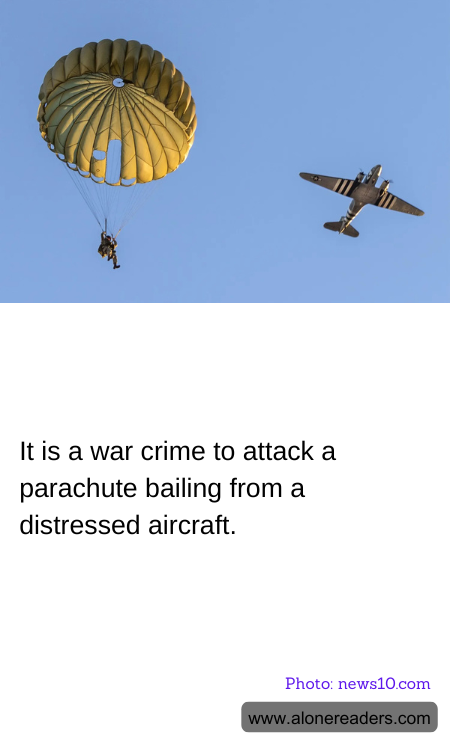
In the theater of war, where chaos and destruction often reign supreme, there exist certain rules and conventions designed to maintain a semblance of humanity amidst the turmoil. One such rule, enshrined in international humanitarian law, is the prohibition against attacking individuals who are parachuting from a distressed aircraft. This principle is not merely a guideline but a binding rule that, when violated, constitutes a war crime.
The origins of this rule can be traced back to the Geneva Conventions, which are a series of treaties and protocols that establish international legal standards for humanitarian treatment in war. Specifically, the rule against attacking parachutists is articulated in the Protocol I of the Geneva Conventions, adopted in 1977. This protocol explicitly states that persons parachuting from an aircraft in distress should not be attacked during their descent. The rationale behind this rule is rooted in the fundamental principles of humanity and the protection of those who are hors de combat, or out of the fight.
When an aircraft is in distress, its crew and passengers are rendered defenseless as they bail out, relying on parachutes to safely reach the ground. At this moment, they are no longer combatants but individuals seeking survival. Attacking them during this vulnerable state is considered an act of unnecessary cruelty and a violation of the laws of war. Such actions undermine the very essence of military ethics and the respect for human life, which are core tenets of international humanitarian law.
The prohibition against attacking parachutists is not only a legal obligation but also a moral one. It reflects the broader commitment of the international community to uphold human dignity even in the direst of circumstances. By adhering to this rule, warring parties demonstrate a respect for life and a commitment to conduct hostilities in a manner that minimizes unnecessary suffering. This principle serves as a reminder that even in war, there are limits to what is permissible, and that the rules of engagement must be guided by a sense of humanity.
Violations of this rule are taken seriously by the international community. Those found guilty of attacking parachutists from distressed aircraft can be prosecuted for war crimes, facing severe penalties. Such accountability mechanisms are crucial in deterring future violations and ensuring that the rules of war are respected.
In conclusion, the prohibition against attacking parachutists from distressed aircraft is a vital component of international humanitarian law. It underscores the importance of maintaining humanity in warfare and protecting those who are defenseless. By upholding this rule, the international community reaffirms its commitment to the principles of compassion and respect for human life, even amidst the horrors of war.