More About This Card
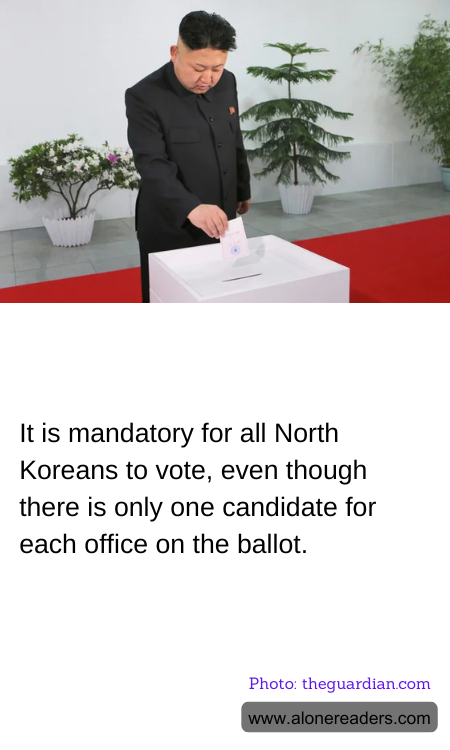
In North Korea, the electoral process is a unique phenomenon that starkly contrasts with democratic practices observed in many other parts of the world. While voting is a mandatory civic duty for all citizens, the elections themselves offer no real choice, as there is only one candidate for each office on the ballot. This peculiar system raises questions about the nature of democracy and the role of elections in a totalitarian regime.
The electoral process in North Korea is designed to project an image of popular participation and legitimacy. Every five years, citizens are required to vote in elections for the Supreme People's Assembly, the country's highest legislative body. However, the outcome is predetermined, as the ruling Workers' Party of Korea, led by the Kim dynasty, selects the sole candidate for each position. This candidate is typically a member of the party or a closely affiliated organization, ensuring that the leadership's control remains unchallenged.
Despite the lack of genuine competition, voter turnout is reported to be nearly 100%, a figure that is both impressive and indicative of the compulsory nature of the process. Failure to vote is not an option for North Koreans, as it could lead to severe repercussions, including suspicion of disloyalty to the regime. The act of voting, therefore, becomes a demonstration of allegiance to the state rather than an expression of individual political preference.
The single-candidate system is justified by the North Korean government as a means of maintaining unity and stability. The regime argues that a unified front is essential for the country's survival in the face of external threats and internal challenges. By eliminating electoral competition, the government claims to prevent divisiveness and ensure that the nation's focus remains on collective goals rather than individual ambitions.
Critics, however, view this system as a façade that masks the absence of true democratic principles. They argue that the lack of choice undermines the very essence of an election, which is to provide citizens with the power to influence their governance. The North Korean model, they contend, is a tool for consolidating power and suppressing dissent, rather than empowering the populace.
For outsiders, the North Korean electoral process serves as a reminder of the complexities and variations in governance systems worldwide. It highlights the challenges faced by citizens living under authoritarian regimes and underscores the importance of advocating for genuine democratic practices. While the act of voting is universally recognized as a fundamental right, its implementation in North Korea reveals how it can be manipulated to serve the interests of a select few rather than the broader population.
In conclusion, the mandatory voting system in North Korea, with its single-candidate ballots, is a striking example of how elections can be used to reinforce authoritarian rule. It prompts reflection on the true meaning of democracy and the ongoing struggle for political freedom in various parts of the world.