More About This Card
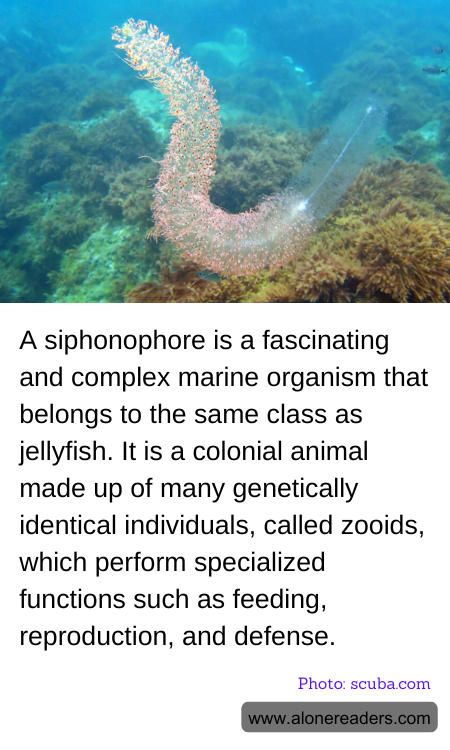
The ocean is home to a myriad of intriguing creatures, but few are as captivating as the siphonophore. Belonging to the same class as jellyfish, these marine organisms are a testament to the complexity and diversity of life beneath the waves. Unlike most animals, a siphonophore is not a single organism but a colonial entity composed of numerous genetically identical individuals known as zooids. Each zooid is specialized to perform specific functions, such as feeding, reproduction, or defense, making the siphonophore a marvel of biological cooperation and specialization.
Siphonophores are often mistaken for jellyfish due to their gelatinous appearance and drifting nature. However, their colonial structure sets them apart. The zooids are so intricately connected that they function as a single organism, each playing a vital role in the survival of the colony. This division of labor is akin to the organs of a body, where each part has a distinct purpose yet works in harmony with the others. For instance, some zooids are equipped with tentacles to capture prey, while others are responsible for digestion or reproduction. This specialization allows siphonophores to efficiently exploit their environment and thrive in the ocean's depths.
One of the most famous siphonophores is the Portuguese man o' war, often mistaken for a jellyfish due to its translucent, balloon-like float that sits above the water's surface. This float, or pneumatophore, is filled with gas and allows the colony to drift with the currents. Beneath it, long tentacles dangle, equipped with venomous cells to capture unsuspecting prey. Despite its beauty, the Portuguese man o' war is a formidable predator, and its sting can be painful to humans.
Siphonophores inhabit various oceanic environments, from the surface to the deep sea. Some species can grow to impressive lengths, with the longest known siphonophore measuring over 40 meters, making it one of the longest animals in the world. Their ethereal beauty and bioluminescent displays, often seen in the deep sea, add to their allure, captivating scientists and ocean enthusiasts alike.
The study of siphonophores offers valuable insights into the evolution of complex life forms and the mechanisms of cooperation and specialization. These creatures challenge our understanding of individuality and collective existence, blurring the lines between single organisms and colonial entities. As we continue to explore the ocean's depths, siphonophores remind us of the incredible diversity and adaptability of life on Earth, inspiring awe and curiosity in equal measure.