More About This Card
In the annals of scientific discovery, serendipity often plays a pivotal role, and the story of Henri Becquerel's accidental discovery of radioactivity is a testament to this phenomenon. In 1896, while investigating the properties of phosphorescent materials, Becquerel stumbled upon a revelation that would forever alter the landscape of physics and chemistry. His curiosity about the natural world led him to explore the behavior of uranium salts, a substance known for its ability to glow after exposure to sunlight.
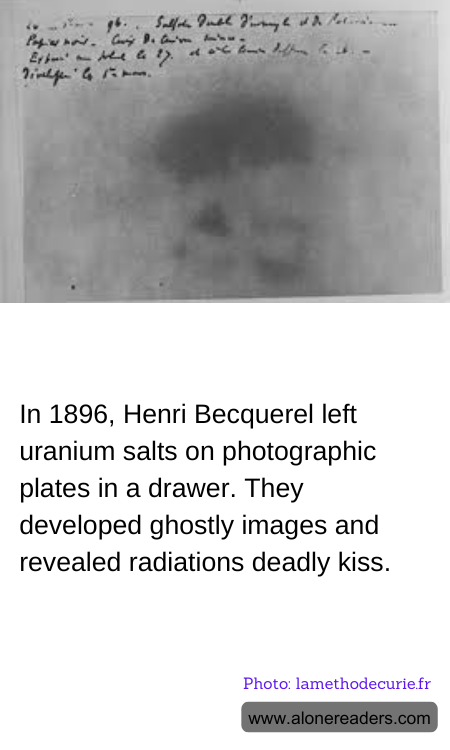
Becquerel's initial experiments involved placing uranium salts on photographic plates wrapped in black paper, intending to expose them to sunlight to observe the phosphorescent effects. However, nature had other plans. A series of overcast days in Paris thwarted his attempts to harness the sun's rays, and he set the plates aside in a drawer, inadvertently leaving them in the dark. When he later developed the plates, he was astonished to find ghostly images imprinted upon them, despite the absence of any light exposure.
This unexpected result piqued Becquerel's interest, prompting him to delve deeper into the mysterious phenomenon. Through meticulous experimentation, he deduced that the uranium salts emitted a form of radiation capable of penetrating the black paper and affecting the photographic plates. This radiation, unlike anything previously documented, did not rely on an external energy source such as sunlight. It was an intrinsic property of the uranium itself.
Becquerel's discovery laid the groundwork for the burgeoning field of nuclear physics. His findings were soon expanded upon by other pioneering scientists, most notably Marie and Pierre Curie, who coined the term "radioactivity" and isolated new radioactive elements, including polonium and radium. The Curies' work further illuminated the potential and perils of radioactive materials, leading to advancements in medicine, energy, and industry, while also highlighting the need for caution due to the harmful effects of radiation exposure.
The revelation of radioactivity's "deadly kiss" was a double-edged sword. On one hand, it unlocked new possibilities for scientific exploration and technological innovation. On the other, it underscored the importance of understanding and respecting the power of nature's hidden forces. The legacy of Becquerel's discovery is a reminder of the delicate balance between curiosity and caution, a balance that continues to guide scientific inquiry today.
Henri Becquerel's chance encounter with radioactivity serves as a poignant reminder of the unpredictable nature of scientific discovery. It underscores the value of open-mindedness and perseverance in the face of unexpected results. As we continue to explore the mysteries of the universe, the story of Becquerel and his ghostly images remains an inspiring testament to the power of curiosity and the enduring quest for knowledge.