More About This Card
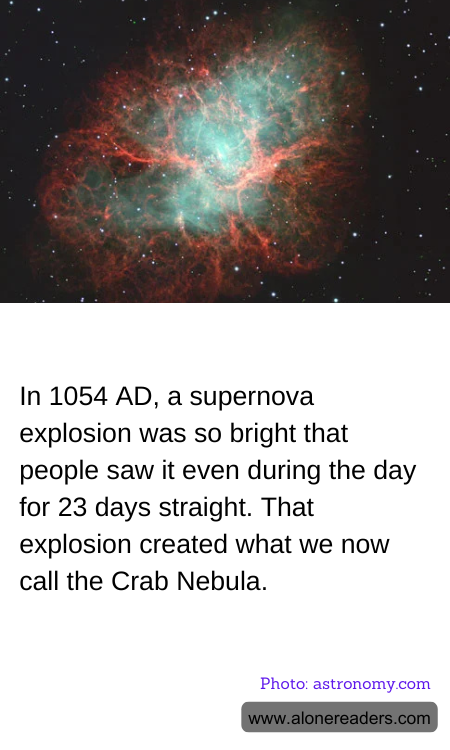
In the year 1054 AD, a celestial event unfolded that would leave an indelible mark on both the night and day skies of Earth. A supernova explosion, so luminous and powerful, erupted in the cosmos, capturing the attention of sky watchers across the globe. This extraordinary event was so bright that it was visible even during the day for an astonishing 23 days. The remnants of this cosmic spectacle have since evolved into what we now know as the Crab Nebula, a fascinating and enduring testament to the dynamic nature of our universe.
The supernova of 1054 was meticulously documented by astronomers and observers from various cultures, including the Chinese, Japanese, and Native American peoples. These early astronomers recorded the event with awe, noting its brilliance and the unusual occurrence of a "guest star" that outshone even the brightest stars in the sky. The supernova was visible in the constellation Taurus, and its brightness rivaled that of Venus, making it a prominent feature in the sky both day and night.
The explosion that created the Crab Nebula was the death throes of a massive star, a cataclysmic event that occurs when a star exhausts its nuclear fuel and collapses under its own gravity. This collapse triggers a powerful explosion, ejecting vast amounts of material into space. The remnants of this explosion form a nebula, a cloud of gas and dust that glows with the energy released during the supernova. The Crab Nebula, located approximately 6,500 light-years from Earth, is one of the most studied and well-known nebulae in the universe.
Today, the Crab Nebula continues to captivate astronomers and space enthusiasts alike. It is a rich source of information about the life cycle of stars and the processes that govern our universe. The nebula is powered by a pulsar, a rapidly rotating neutron star that emits beams of radiation. This pulsar is the dense core left behind after the supernova explosion, and it spins at an incredible rate of about 30 times per second. The energy from the pulsar illuminates the surrounding nebula, creating a stunning display of colors and patterns that can be observed through telescopes.
The legacy of the 1054 supernova and the Crab Nebula extends beyond its scientific significance. It serves as a reminder of the interconnectedness of the cosmos and the shared history of humanity's fascination with the stars. The event has inspired countless stories, myths, and artistic representations throughout history, highlighting the profound impact that celestial phenomena have on human culture and imagination.
In a universe filled with wonders, the Crab Nebula stands as a beacon of discovery and curiosity. It invites us to look up, to explore, and to ponder the mysteries of the cosmos, just as those who witnessed the supernova in 1054 did nearly a millennium ago.