More About This Card
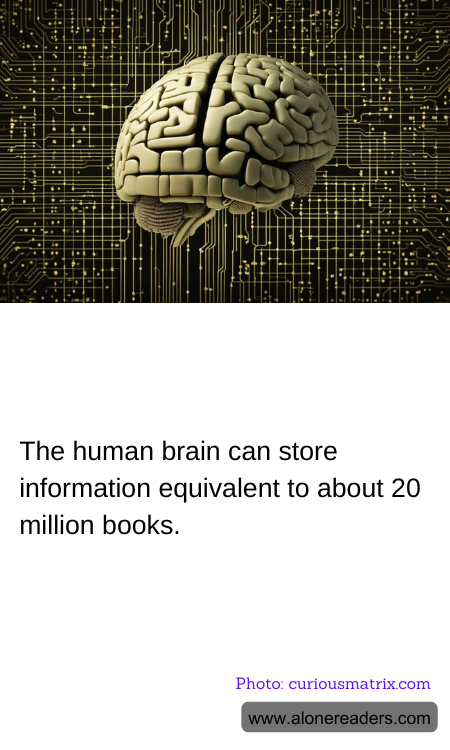
The human brain is an extraordinary organ, often described as the most complex structure in the known universe. One of its most astonishing capabilities is its potential to store information equivalent to about 20 million books. This remarkable capacity underscores the brain's role as a powerful repository of knowledge, memories, and experiences, highlighting its unparalleled efficiency and adaptability.
At the heart of this incredible storage capacity is the brain's approximately 86 billion neurons, each capable of forming thousands of connections with other neurons. These connections, known as synapses, are the pathways through which information travels and is stored. The brain's ability to create and strengthen these synaptic connections is what allows it to store vast amounts of information. Unlike a computer, which stores data in a fixed, linear manner, the brain's storage system is dynamic and adaptable, allowing it to reorganize and optimize itself continually.
The comparison to 20 million books is a testament to the brain's efficiency. If we consider an average book to contain around 500,000 characters, the brain's storage capacity becomes even more impressive. This vast potential is not just about storing raw data; it also involves the ability to process, analyze, and retrieve information in a meaningful way. The brain's storage is not merely a passive repository but an active, living system that enables learning, creativity, and problem-solving.
Despite this immense capacity, the brain does not store information in a way that is easily comparable to digital storage. Memories are not stored in isolated compartments but are distributed across various regions of the brain. This distribution allows for a rich, interconnected web of information, where memories can be reconstructed and reinterpreted based on new experiences and insights. This interconnectedness is what enables humans to draw on past experiences to make decisions, solve problems, and create new ideas.
The brain's storage capacity also highlights the importance of maintaining brain health. Just as a library requires care and organization to function effectively, the brain benefits from activities that promote cognitive health. Engaging in mental exercises, maintaining a healthy diet, getting regular physical activity, and ensuring adequate sleep are all crucial for preserving and enhancing the brain's ability to store and process information.
In conclusion, the human brain's ability to store information equivalent to about 20 million books is a testament to its incredible complexity and efficiency. This capacity not only underscores the brain's role as a powerful tool for learning and adaptation but also highlights the importance of nurturing and protecting this vital organ. As we continue to explore the mysteries of the brain, we gain a deeper appreciation for the remarkable capabilities that lie within each of us.