More About This Card
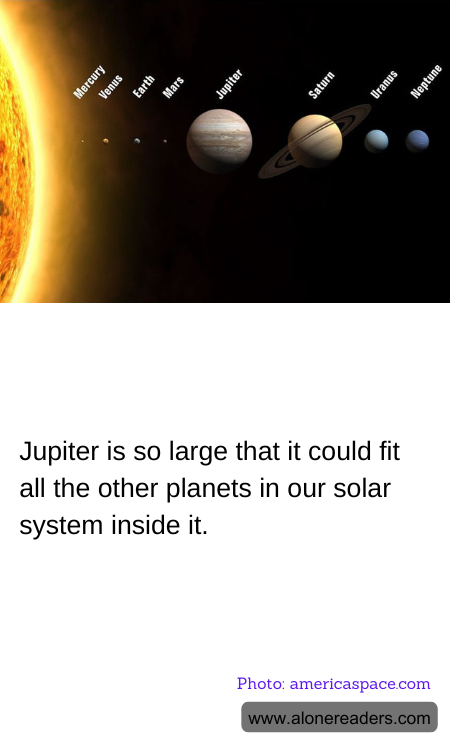
Jupiter, the largest planet in our solar system, is a colossal giant that continues to fascinate astronomers and space enthusiasts alike. Its sheer size is mind-boggling, and when we say that Jupiter is so large it could fit all the other planets in our solar system inside it, we are not exaggerating. This fact alone highlights the immense scale of this gas giant and its dominant presence in our celestial neighborhood.
To put things into perspective, Jupiter's diameter is about 86,881 miles (139,822 kilometers), making it more than 11 times wider than Earth. Its volume is so vast that it could encompass more than 1,300 Earths. When considering the combined volumes of all the other planets, including the rocky terrestrial planets like Mercury, Venus, Earth, and Mars, as well as the gas and ice giants like Saturn, Uranus, and Neptune, they could all fit comfortably within Jupiter's massive expanse. This remarkable capacity underscores Jupiter's status as the king of planets, a title it has held since ancient times.
Jupiter's immense size is primarily due to its composition. Unlike Earth, which is a rocky planet, Jupiter is a gas giant composed mostly of hydrogen and helium. These elements are the lightest and most abundant in the universe, allowing Jupiter to grow to its enormous size without becoming a solid body. Its thick atmosphere, characterized by swirling clouds and the famous Great Red Spot—a gigantic storm larger than Earth itself—adds to its majestic appearance.
The gravitational pull of Jupiter is another aspect that sets it apart. Its strong gravity not only influences the orbits of its own moons, of which there are at least 79, but also affects the entire solar system. Jupiter acts as a cosmic vacuum cleaner, attracting and capturing many asteroids and comets that might otherwise pose a threat to the inner planets, including Earth. This protective role has earned Jupiter the nickname "the solar system's guardian."
Despite its size, Jupiter is not a candidate for human exploration. Its atmosphere is inhospitable, with extreme pressures and temperatures that would crush and incinerate any spacecraft attempting to land. However, studying Jupiter from afar provides valuable insights into the formation and evolution of our solar system. Missions like NASA's Juno spacecraft continue to gather data, revealing the secrets of Jupiter's magnetic field, atmospheric dynamics, and core structure.
In conclusion, Jupiter's ability to fit all the other planets inside it is a testament to its grandeur and significance. As we continue to explore and understand this giant planet, we gain a deeper appreciation for the complexity and beauty of our solar system. Jupiter remains a symbol of the vastness of space and the endless possibilities that lie beyond our home planet, inspiring curiosity and wonder in people of all ages.