More About This Card
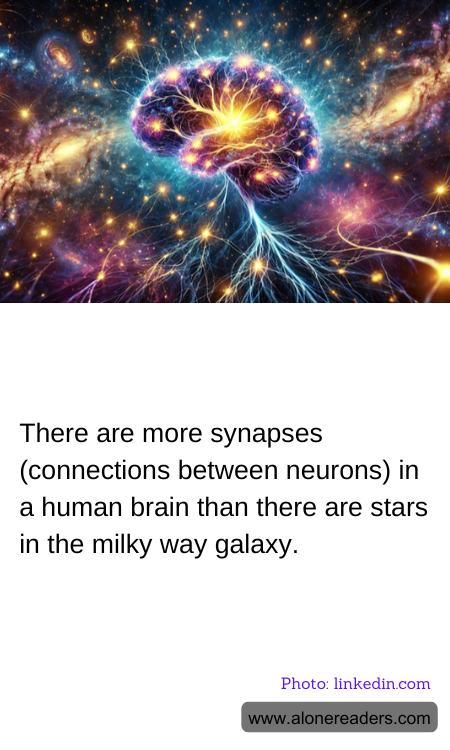
The human brain is an extraordinary organ, a marvel of biological engineering that continues to intrigue scientists and laypeople alike. One of the most fascinating aspects of the brain is its sheer complexity, particularly when it comes to the number of synapses, or connections between neurons. It is often said that there are more synapses in a human brain than there are stars in the Milky Way galaxy, a comparison that underscores the intricate and vast network that constitutes our cognitive and sensory experiences.
The Milky Way galaxy is estimated to contain between 100 billion to 400 billion stars. In comparison, the human brain, with its approximately 86 billion neurons, forms an even more staggering number of synapses. Each neuron can form thousands of connections with other neurons, leading to an estimated 100 trillion synapses in a single human brain. This dense web of connections is what enables the brain to process information, store memories, and generate thoughts and emotions.
The comparison to the Milky Way not only highlights the brain's complexity but also its adaptability. Synapses are not static; they are dynamic structures that can strengthen or weaken over time, a process known as synaptic plasticity. This ability to change is fundamental to learning and memory, allowing the brain to adapt to new experiences and information. It is this plasticity that enables humans to learn new skills, adapt to new environments, and recover from injuries.
Moreover, the brain's synaptic network is not just a testament to its complexity but also to its efficiency. Despite the vast number of connections, the brain operates with remarkable energy efficiency. It uses only about 20 watts of power, roughly the same as a dim light bulb, to perform tasks that range from simple reflexes to complex problem-solving. This efficiency is a result of millions of years of evolution, optimizing the brain's structure and function to meet the demands of survival and adaptation.
The comparison between synapses and stars also serves as a humbling reminder of the mysteries that both the cosmos and the human brain still hold. Just as astronomers continue to explore the vastness of the universe, neuroscientists are constantly uncovering new insights into how the brain works. Each discovery brings us closer to understanding the full potential of the human mind and its capacity for creativity, innovation, and empathy.
In essence, the human brain, with its countless synapses, is a universe unto itself, a testament to the wonders of nature and evolution. It is a reminder of the incredible potential that lies within each of us, waiting to be explored and understood. As we continue to delve into the mysteries of the brain, we not only learn more about ourselves but also gain a deeper appreciation for the intricate tapestry of life that connects us all.