More About This Card
In the late 18th and 19th centuries, a peculiar and macabre practice emerged in New England, driven by the widespread fear and misunderstanding of tuberculosis, then commonly referred to as consumption. This disease, characterized by a relentless wasting away of the body, was a leading cause of death and was often perceived as a mysterious and unstoppable force. In an era before modern medical understanding, communities were desperate to find a cure or at least a way to halt its spread.
The practice involved exhuming the bodies of those who had succumbed to tuberculosis. It was believed that the deceased, particularly if they were the first in a family to die from the disease, might be feeding off the life force of the living, causing the illness to persist and spread among relatives. This belief was rooted in folklore and the notion of the "vampire," although it was not associated with the blood-sucking creatures of later popular culture. Instead, these "vampires" were thought to be draining the vitality of their living kin from beyond the grave.
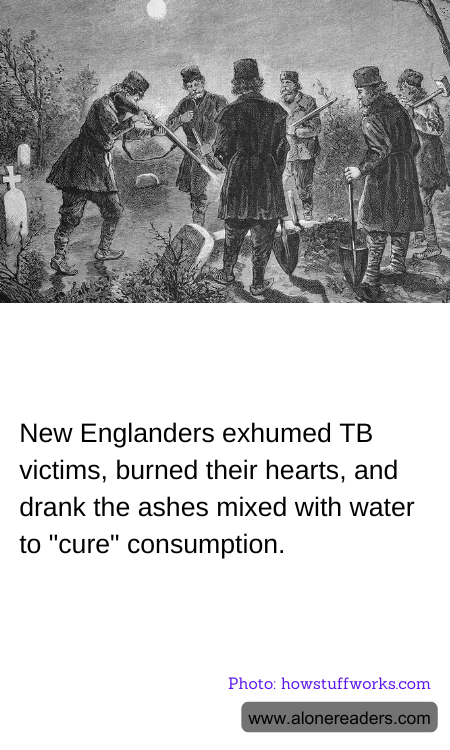
Once exhumed, the heart of the deceased was removed and burned. The ashes from the heart were then mixed with water to create a concoction that was consumed by the afflicted family members. This ritual was thought to break the supernatural hold the deceased had over the living, thereby curing or at least protecting them from further harm. While this practice may seem shocking today, it was a desperate measure taken by communities grappling with a disease they could not understand or control.
This ritual was not universally practiced across New England but was more common in rural areas where traditional beliefs held sway and medical resources were scarce. The practice was documented in several cases, with one of the most famous being that of Mercy Brown in Rhode Island in 1892. Her family, ravaged by tuberculosis, resorted to exhuming her body and performing the ritual in a last-ditch effort to save her brother, who was also suffering from the disease.
The exhumation and consumption of ashes highlight the lengths to which people will go when faced with fear and uncertainty. It serves as a reminder of the historical context of medical practices and the evolution of our understanding of disease. Today, tuberculosis is a well-understood bacterial infection, treatable with antibiotics, but the story of New England's "vampire" rituals remains a fascinating glimpse into the past, illustrating how cultural beliefs and medical practices can intersect in unexpected ways.