More About This Card
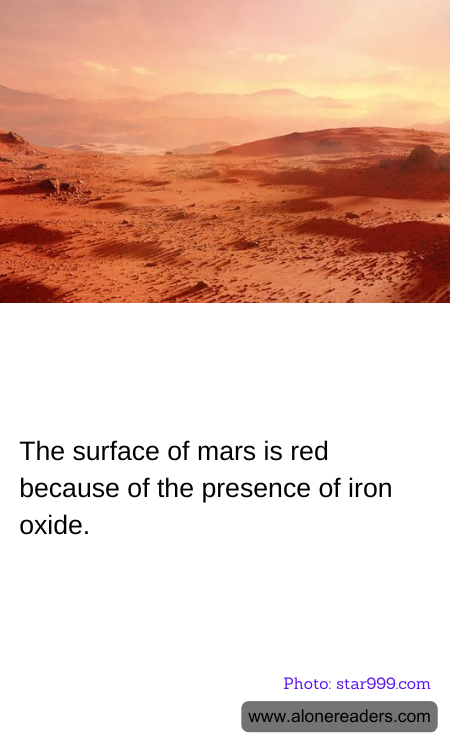
Mars, often referred to as the "Red Planet," has captivated human imagination for centuries. Its distinct reddish hue is one of its most defining characteristics, easily visible even from Earth. This striking color is primarily due to the presence of iron oxide, commonly known as rust, which coats the planet's surface.
Iron oxide is a compound that forms when iron reacts with oxygen. On Earth, we see this process in the rusting of iron objects. Similarly, on Mars, iron in the soil and rocks has reacted with trace amounts of oxygen present in the Martian atmosphere, resulting in a widespread layer of iron oxide. This gives the planet its reddish appearance, which can range from a bright, fiery red to a more subdued, rusty brown, depending on the location and the time of day.
The presence of iron oxide on Mars is not just a superficial feature; it provides valuable insights into the planet's history and environmental conditions. Scientists believe that Mars once had a much thicker atmosphere and possibly liquid water on its surface. The iron oxide suggests that there was enough oxygen in the past to facilitate the rusting process, hinting at a time when Mars might have been more Earth-like. This has significant implications for the possibility of past life on Mars, as liquid water and a thicker atmosphere could have supported microbial life.
The exploration of Mars has been a major focus for space agencies around the world. Rovers like Spirit, Opportunity, and Curiosity have traversed the Martian surface, analyzing soil and rock samples to understand the planet's geology and climate history. These missions have confirmed the widespread presence of iron oxide and have also discovered other minerals that form in the presence of water, further supporting the theory that Mars was once a wetter planet.
Understanding why Mars is red is not just a matter of scientific curiosity; it also helps us prepare for future human exploration. The iron-rich soil poses challenges for landing spacecraft and could affect the health of astronauts due to its fine, pervasive dust. However, it also presents opportunities. Iron is a valuable resource that could be used in construction and manufacturing on Mars, reducing the need to transport materials from Earth.
In conclusion, the red surface of Mars, caused by iron oxide, is more than just a visual feature. It is a window into the planet's past, offering clues about its climate, atmosphere, and potential for life. As we continue to explore Mars, the red planet will undoubtedly reveal more of its secrets, bringing us closer to understanding our place in the universe.