More About This Card
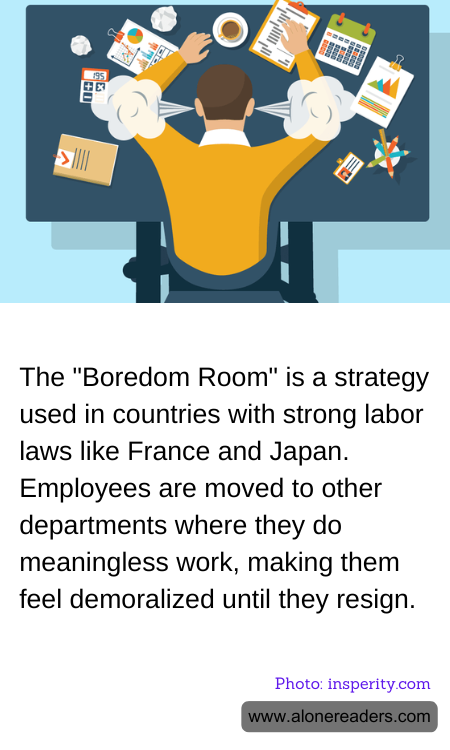
In the intricate world of employment, where labor laws are designed to protect workers' rights, a curious phenomenon known as the "Boredom Room" has emerged in countries like France and Japan. This strategy, while not officially sanctioned, is a subtle yet potent tool used by some companies to navigate the complexities of strong labor protections. At its core, the "Boredom Room" involves transferring employees to departments where they are assigned tasks that are either meaningless or significantly below their skill level. The ultimate aim is to demoralize these employees to the point where they choose to resign voluntarily.
The concept of the "Boredom Room" is a reflection of the challenges faced by employers in countries with stringent labor laws. In places like France and Japan, terminating an employee can be a lengthy and costly process, often requiring substantial evidence of misconduct or underperformance. As a result, some companies resort to this indirect method to encourage voluntary resignations, thereby sidestepping the legal and financial hurdles associated with formal dismissals.
For the employees subjected to this strategy, the experience can be profoundly disheartening. Being assigned to perform trivial tasks or being left with little to no work can lead to a sense of worthlessness and frustration. This tactic not only affects their professional self-esteem but can also have broader implications on their mental well-being. The lack of meaningful engagement and the feeling of being sidelined can erode an employee's motivation and job satisfaction, ultimately pushing them to seek opportunities elsewhere.
While the "Boredom Room" may seem like a clever workaround for employers, it raises significant ethical concerns. It highlights a disconnect between the intent of labor laws and the realities of workplace practices. Labor laws are designed to protect employees from unfair treatment and ensure job security, yet the existence of such strategies suggests that there are gaps in how these laws are implemented and enforced. Moreover, this practice can contribute to a toxic work environment, undermining trust and morale across the organization.
Addressing the issue of the "Boredom Room" requires a multifaceted approach. Employers need to recognize the long-term benefits of fostering a positive and engaging work environment. This includes investing in employee development, providing clear career progression paths, and ensuring that all employees feel valued and challenged in their roles. For policymakers, there is a need to strengthen the enforcement of labor laws and close loopholes that allow such practices to persist.
Ultimately, the "Boredom Room" serves as a reminder of the delicate balance between protecting workers' rights and maintaining organizational flexibility. By fostering open communication and mutual respect between employers and employees, it is possible to create workplaces where both parties can thrive without resorting to demoralizing tactics.