More About This Card
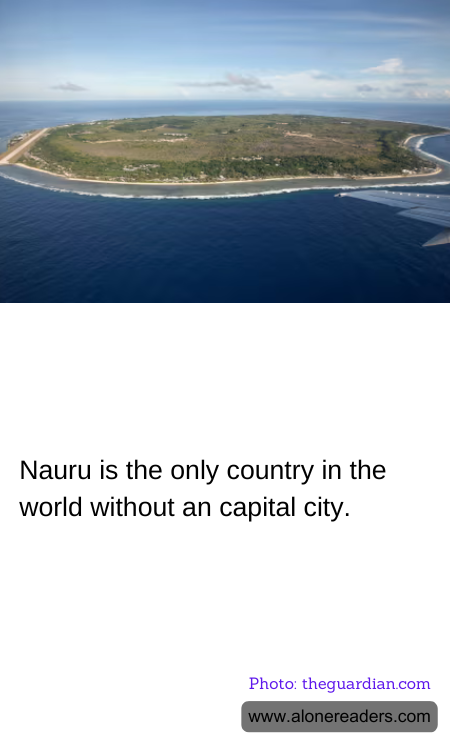
Nauru, a small island nation in the Pacific Ocean, holds the unique distinction of being the only country in the world without an official capital city. This intriguing fact sets Nauru apart from the other 195 countries globally, each of which typically designates a city as its political and administrative hub. The absence of a capital city in Nauru is not merely a geographical curiosity but also a reflection of its distinctive history, culture, and governance.
Located just south of the equator, Nauru is one of the world's smallest countries, both in terms of land area and population. Covering just 21 square kilometers, the entire island is home to around 10,000 residents. This compact size contributes to the lack of a need for a designated capital. The country's government operations are centralized in the Yaren District, which functions as the de facto capital. Yaren houses the parliament and government offices, serving as the administrative heart of the island. However, it is not officially recognized as the capital, a status that remains unclaimed by any part of Nauru.
The absence of a capital city can be traced back to Nauru's unique historical and political journey. Originally inhabited by Micronesian and Polynesian peoples, Nauru was annexed by Germany in the late 19th century and later administered by Australia, New Zealand, and the United Kingdom under a League of Nations mandate. It gained independence in 1968, and since then, the island's small size and population have made the formal establishment of a capital city unnecessary. The centralized nature of governance in Yaren has sufficed for the island's administrative needs.
Nauru's lack of a capital city also reflects its cultural and social dynamics. The island's community-oriented lifestyle and close-knit society mean that the functions typically associated with a capital city are spread across the island. This distribution of roles and responsibilities aligns with the Nauruan way of life, where community and family ties are paramount. The island's infrastructure, including schools, hospitals, and businesses, is evenly distributed, further diminishing the need for a centralized capital.
Despite its small size and unique status, Nauru faces challenges common to many nations, such as economic development and environmental sustainability. The island's economy has historically relied on phosphate mining, which has led to environmental degradation. Efforts are underway to diversify the economy and address these issues, with international partnerships playing a crucial role.
In conclusion, Nauru's distinction as the only country without a capital city is a testament to its unique identity and history. While it may lack a formal capital, the island's governance and community life continue to thrive in a manner that suits its size and cultural values. This singular characteristic adds to the rich tapestry of global diversity, highlighting how nations can function effectively outside conventional norms.