More About This Card
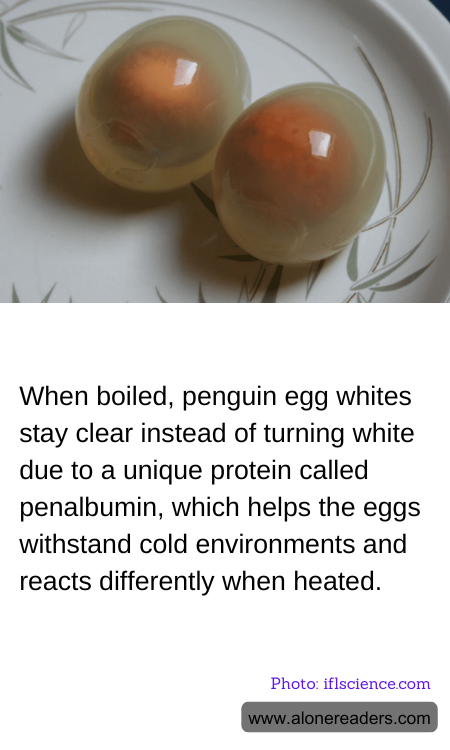
Penguins, the charismatic flightless birds of the Southern Hemisphere, are known for their remarkable adaptations to some of the harshest climates on Earth. Among their many fascinating traits, the unique properties of their eggs stand out, particularly the behavior of their egg whites when boiled. Unlike the egg whites of most birds, which turn opaque white upon cooking, penguin egg whites remain clear. This intriguing phenomenon is attributed to a special protein called penalbumin.
Penalbumin is a protein that plays a crucial role in the survival of penguin eggs in extremely cold environments. In the frigid conditions of Antarctica and other cold regions where penguins reside, maintaining the integrity of the egg is vital for the development of the embryo. Penalbumin helps achieve this by providing structural stability to the egg whites, allowing them to remain resilient against freezing temperatures. This protein's unique properties ensure that the egg whites do not crystallize or become damaged, which could otherwise jeopardize the embryo's development.
The behavior of penalbumin under heat is what sets penguin eggs apart from those of other birds. Typically, when egg whites are heated, the proteins denature and coagulate, turning the whites from clear to opaque. However, penalbumin reacts differently. Its molecular structure is such that it does not undergo the same transformation when exposed to heat. As a result, even when boiled, the egg whites of penguin eggs retain their clear appearance. This characteristic not only highlights the adaptability of penguins to their environment but also underscores the diversity of nature's solutions to survival challenges.
For scientists and researchers, the study of penalbumin offers insights into protein behavior and adaptation. Understanding how penalbumin functions could have broader implications, potentially informing the development of new materials or preservation techniques that mimic its properties. Moreover, this knowledge adds to the growing body of research on how animals have evolved to thrive in extreme conditions, providing a window into the complex interplay between biology and environment.
For the general public, the story of penguin eggs and penalbumin serves as a reminder of the wonders of the natural world. It illustrates how even the smallest details, such as the composition of an egg white, can be finely tuned by evolution to meet specific ecological needs. As we continue to explore and learn from nature, the unique characteristics of penguin eggs stand as a testament to the ingenuity of life on Earth.