More About This Card
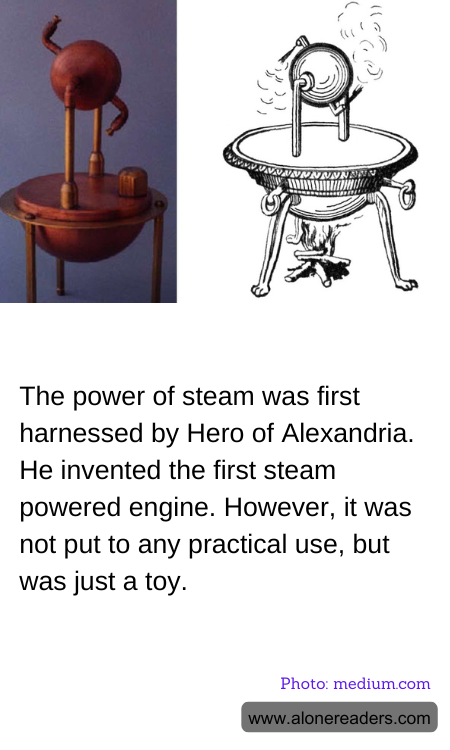
In the annals of history, the power of steam is often associated with the industrial revolution and the transformative changes it brought to society. However, the origins of harnessing steam power date back much further, to the ancient world, where a remarkable figure named Hero of Alexandria first explored its potential. Hero, a Greek engineer and mathematician of the first century AD, is credited with inventing the earliest known steam-powered engine, a device that, while not utilized for practical purposes, demonstrated the intriguing possibilities of steam.
Hero's invention, known as the aeolipile, was a simple yet ingenious device. It consisted of a hollow sphere mounted on a pair of tubes that allowed steam to escape. When water inside the sphere was heated, steam was produced, which then exited through the tubes, causing the sphere to rotate. This rotation was the result of the reactive force of the steam jets, a principle that would later be understood as a precursor to the modern concept of jet propulsion. Despite its simplicity, the aeolipile was a significant leap in understanding the potential of steam as a source of power.
While Hero's aeolipile was a marvel of engineering for its time, it was regarded more as a curiosity or a toy rather than a tool for practical application. The ancient world lacked the technological framework and industrial needs that would later drive the development of steam power. As a result, Hero's invention remained largely a demonstration of scientific principles rather than a catalyst for technological advancement. Nonetheless, it laid the groundwork for future innovators who would eventually harness steam power to revolutionize industries and transportation.
The story of Hero of Alexandria and his aeolipile is a testament to the enduring spirit of human curiosity and innovation. It highlights how ideas that may initially seem impractical or whimsical can, over time, inspire profound changes in society. While Hero's steam engine did not find immediate application, it sparked a legacy of exploration into the potential of steam power. This legacy would eventually culminate in the steam engines of the 18th and 19th centuries, which powered factories, locomotives, and ships, reshaping the world in ways Hero could scarcely have imagined.
In reflecting on Hero's contribution, we are reminded of the importance of nurturing creativity and experimentation, even when immediate practical applications are not apparent. The aeolipile serves as a symbol of the boundless possibilities that arise from human ingenuity, encouraging us to explore and innovate, knowing that today's curiosities may become tomorrow's breakthroughs. Hero of Alexandria's pioneering work with steam power is a fascinating chapter in the history of technology, illustrating how the seeds of innovation can be planted long before they bear fruit.