More About This Card
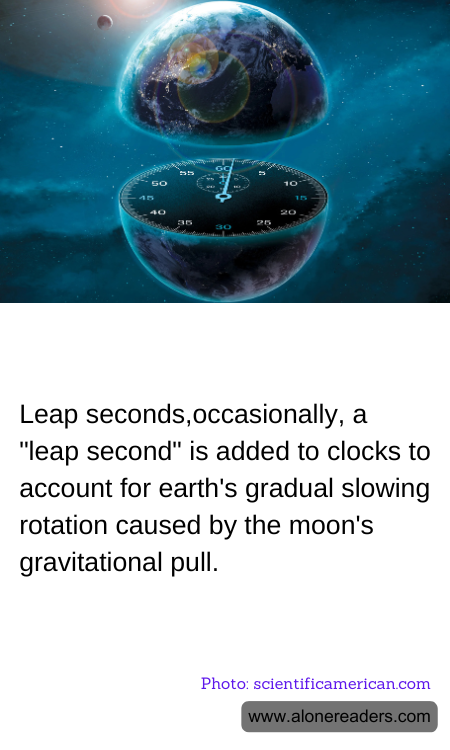
In the intricate dance of celestial bodies, the Earth and the Moon share a gravitational relationship that subtly influences our planet's rotation. This gravitational pull, primarily from the Moon, causes the Earth's rotation to gradually slow down over time. To account for this deceleration and ensure that our clocks remain in sync with the Earth's rotation, scientists occasionally add a "leap second" to our timekeeping systems.
The concept of a leap second might seem abstract, but it plays a crucial role in maintaining the precision of Coordinated Universal Time (UTC), the standard used worldwide. UTC is based on highly accurate atomic clocks, which measure time with remarkable precision. However, the Earth's rotation is not as consistent, fluctuating due to various factors, including the gravitational interactions with the Moon and other celestial bodies. These fluctuations mean that, over time, the atomic time and the solar time (based on Earth's rotation) can drift apart.
To bridge this gap, leap seconds are added. Since the practice began in 1972, leap seconds have been inserted at the end of June or December, depending on the accumulated discrepancy. This adjustment ensures that the difference between atomic time and solar time remains within 0.9 seconds, preserving the alignment of our clocks with the position of the Sun in the sky.
The addition of a leap second is a rare event, occurring only when necessary. It is determined by the International Earth Rotation and Reference Systems Service (IERS), which monitors the Earth's rotation and decides when a leap second is needed. This decision is based on precise measurements and predictions of the Earth's rotational speed.
While the insertion of a leap second might seem trivial, it has significant implications for various sectors, particularly those relying on precise timekeeping. Industries such as telecommunications, navigation, and financial markets depend on accurate time synchronization. A leap second can pose challenges for computer systems and networks, which must be updated to accommodate the extra second. Despite these challenges, the adjustment is essential to maintain the accuracy and reliability of global timekeeping.
For the general public, the addition of a leap second often goes unnoticed, a testament to the seamless integration of this adjustment into our daily lives. However, it serves as a reminder of the dynamic nature of our planet and the intricate systems we have developed to measure and understand time. As we continue to explore the universe and deepen our understanding of celestial mechanics, the leap second remains a fascinating example of how human ingenuity adapts to the ever-changing rhythms of the cosmos.