More About This Card
Liquid oxygen, a fascinating substance with unique properties, has intrigued scientists and enthusiasts alike due to its magnetic characteristics. Unlike the oxygen we breathe, which is a gas at room temperature, liquid oxygen is formed when oxygen is cooled to extremely low temperatures, specifically below -183 degrees Celsius (-297 degrees Fahrenheit). At this temperature, oxygen transitions into a pale blue liquid that exhibits paramagnetic properties, meaning it is attracted to magnetic fields.
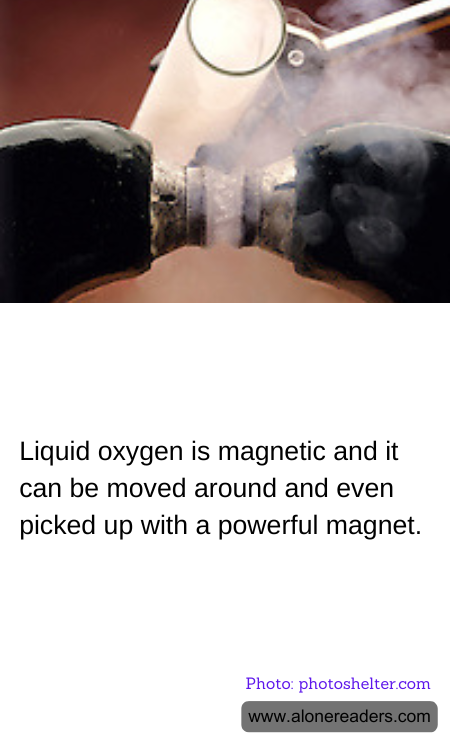
The magnetic nature of liquid oxygen is attributed to its molecular structure. Oxygen molecules (O2) have unpaired electrons, which create a magnetic moment. This magnetic moment allows liquid oxygen to be influenced by external magnetic fields. When exposed to a powerful magnet, liquid oxygen can be moved around, manipulated, and even picked up, a phenomenon that is both visually captivating and scientifically significant.
The ability to move liquid oxygen with a magnet is not just a laboratory curiosity; it has practical implications in various fields. In scientific research, understanding the magnetic properties of liquid oxygen can aid in the study of magnetic materials and the development of new technologies. For instance, in the field of cryogenics, where extremely low temperatures are utilized, the magnetic manipulation of liquid oxygen can be applied in cooling systems and magnetic levitation experiments.
Moreover, the magnetic properties of liquid oxygen have educational value, serving as a tangible demonstration of the principles of magnetism and molecular physics. It provides a unique opportunity for educators to engage students in discussions about the behavior of materials at different temperatures and the role of electron configurations in determining magnetic properties. This hands-on experience can spark curiosity and inspire future generations to explore the wonders of science.
Despite its intriguing properties, handling liquid oxygen requires caution due to its extremely low temperature and potential reactivity. It is a powerful oxidizer, meaning it can accelerate combustion processes, posing a risk if not managed properly. Therefore, experiments involving liquid oxygen should be conducted with appropriate safety measures and under controlled conditions.
In conclusion, the magnetic nature of liquid oxygen is a remarkable example of how the fundamental principles of physics manifest in the natural world. Its ability to be manipulated by magnets not only provides insight into the behavior of materials at cryogenic temperatures but also opens up possibilities for scientific exploration and technological innovation. As we continue to explore the properties of materials under extreme conditions, liquid oxygen remains a captivating subject that bridges the gap between theoretical concepts and practical applications, captivating the imagination of people of all ages.