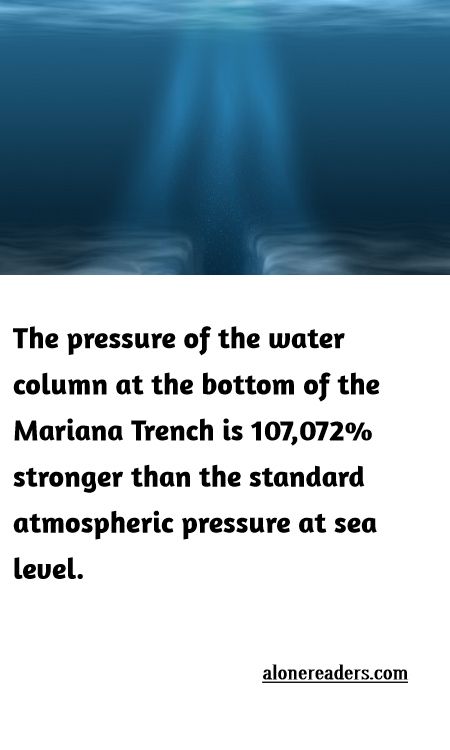
Exploring the depths of the ocean, especially the Mariana Trench, provides a stark perspective on the extreme conditions under which life and geological processes occur. The Mariana Trench, located in the western Pacific Ocean, is the deepest part of the world's oceans. At its lowest point, known as the Challenger Deep, the depth reaches nearly 36,000 feet below sea level. Such an immense depth means that the environmental conditions there, especially the pressure, are extraordinarily harsh.
The pressure at the bottom of the Mariana Trench is approximately 1,071 times greater than the pressure at sea level, which is about 1 atmosphere or 14.7 pounds per square inch (psi). At the Challenger Deep, pressure mounts to about 15,750 psi. This is equivalent to experiencing the weight of about 50 jumbo jets pressing down on a person's body. This intense pressure is due to the weight of the water column above the trench bottom; the deeper one goes, the more water is above, pressing down.
Despite these inhospitable conditions, life thrives even at the depths of the Mariana Trench. Organisms like xenophyophores, amphipods, and certain types of fish have adapted to survive this extreme pressure, along with near-freezing temperatures and complete darkness, apart from the light they themselves might produce through bioluminescence. The existence of life at these depths challenges our understanding of survival and adaptation and pushes the boundaries of biochemistry.
Moreover, studying the pressure and environmental features of deep-sea trenches like the Mariana Trench helps scientists understand Earth's geological activities better. These deep regions are key in tectonic plate movements and interactions, potentially offering insights into seismic activity patterns such as earthquakes and tsunamis. By studying the pressure conditions and geological structures in these depths, researchers can also learn more about the Earth’s composition and the processes shaping its surface.
Therefore, the intense pressure at the bottom of the Mariana Trench not only represents a monumental challenge for life to exist and endure but also serves as a natural laboratory for scientific research and discovery. Explorations and studies of such extreme environments are crucial for expanding our knowledge of the planet's biodiversity and geological dynamics.
