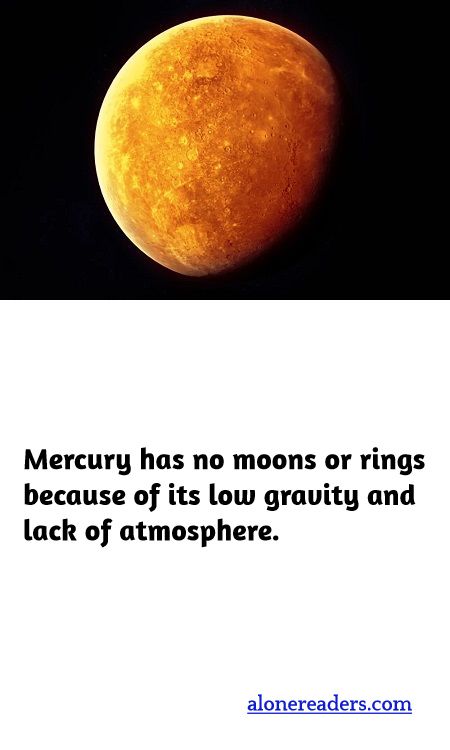
Mercury, the smallest planet in our solar system and the one closest to the Sun, stands out for having no moons or rings. This absence can largely be attributed to two major factors: its low gravity and its almost nonexistent atmosphere. Being only slightly larger than Earth’s moon, Mercury possesses significantly less gravitational pull, which impacts its ability to capture and hold onto objects like moons or sustain a system of rings.
Moreover, Mercury's proximity to the Sun plays a crucial role in this phenomenon. The intense solar radiation and solar winds that Mercury is exposed to have prevented it from developing any significant atmosphere. Without an atmosphere, Mercury lacks the necessary protection and retention of gases or dust that could coalesce into moonlets or rings. This also contributes to its inability to retain any particles that might come close enough to form such structures, as they often get blown away or pulled into different trajectories by solar forces.
Additionally, the gravitational influences of the sun are much more pronounced due to Mercury's closeness. Any potential satellites or debris that might form rings around Mercury would likely be destabilized by the sun’s strong gravitational pull. This results in a high likelihood of these materials being either captured by the Sun or scattered into space, rather than coalescing into a permanent ring or moon system.
Thus, the distinct characteristics of Mercury, including its small mass, lack of atmospheric shield, and proximity to the Sun, collectively prevent the formation of moons and rings around it. As scientists continue to explore and understand our solar system, the unique conditions of each planet, including Mercury, provide significant insights into planetary formation and evolution.
