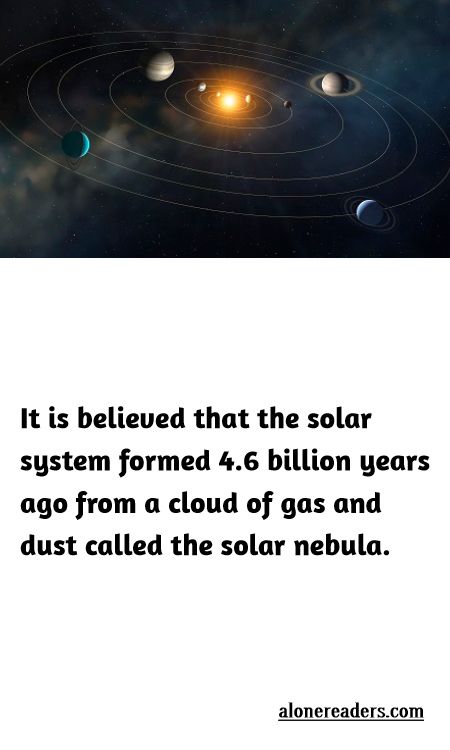
The solar system’s origins trace back to about 4.6 billion years ago, formed from a collapsing cloud of gas and dust known as the solar nebula. This vast cloud, composed mostly of hydrogen and helium, with traces of heavier elements, gradually succumbed to its own gravity. As the nebula contracted, it began to spin, becoming flatter and warmer over time. This process led to the formation of a protostar at the center, which would eventually become our Sun.
Surrounding this nascent star, the remainder of the dust and gas began to coalesce into what are termed planetesimals—small, solid objects that served as the building blocks for the planets. Through a process of accretion, these planetesimals collided and merged, forming larger bodies. Over millions of years, these bodies grew into the planets, moons, and other objects that make up our solar system today.
The inner solar system, where temperatures were higher due to the proximity to the Sun, saw the formation of the terrestrial planets, including Earth. These planets are rocky and dense. In contrast, in the colder outer regions, giant gas planets like Jupiter and Saturn could hold onto lighter gases such as hydrogen and helium, growing to massive sizes.
Throughout its evolution, the solar system has been a dynamic place. Impacts from asteroids and comets have shaped planetary surfaces, and gravitational interactions have altered orbits. Even now, the solar system is not a static system; it continues to evolve subtly as celestial bodies interact.
Understanding how our solar system formed provides not only insights into our own origins but also clues about other planetary systems across the galaxy. As technology advances, astronomers and physicists continue to refine their models of solar system formation, incorporating new discoveries from space missions and telescopic observations. This ongoing exploration helps to piece together the grand puzzle of the universe's structure and the fascinating processes that drive its expansion and transformation.
