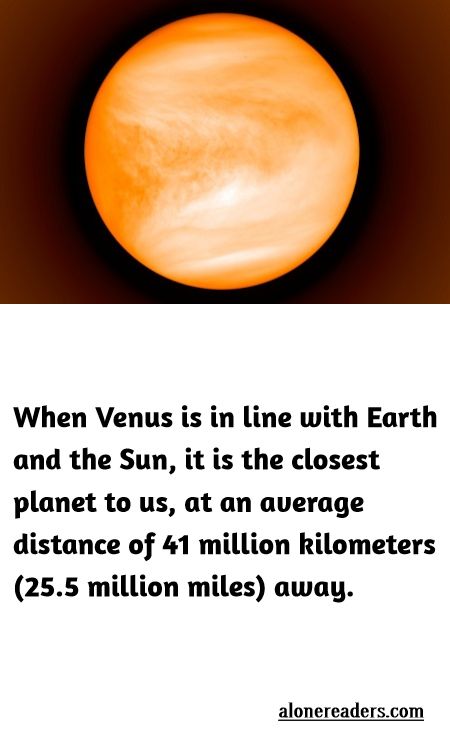
Venus, often referred to as Earth's sister planet due to its similar size and composition, is not only one of our nearest celestial neighbors but also periodically becomes the closest planet to us. This proximity occurs when Venus aligns with Earth and the Sun in an arrangement called inferior conjunction. During this alignment, Venus is both directly between Earth and the Sun and at its closest average distance from Earth, approximately 41 million kilometers (25.5 million miles). Due to the elliptical nature of planetary orbits, this distance can vary slightly with each occurrence.
The phenomenon of being closest to Earth makes Venus an exceptionally bright object in our sky, often visible just before sunrise or after sunset and commonly known as the "Morning Star" or "Evening Star." The brilliance of Venus in our night sky is not just due to its proximity but also because of its highly reflective cloud cover which efficiently scatters sunlight.
The periods when Venus is closest to Earth are significant for both observational astronomy and space mission planning. For astronomers, these alignments are ideal for studying the atmospheric conditions of Venus as well as its surface and thermal characteristics, albeit through powerful telescopes or via spacecraft missions. The Parker Solar Probe, for example, uses Venus' gravitational pull during its close approaches to decrease its orbital distance around the Sun.
For space missions, the close proximity of Venus to Earth when they are aligned allows for optimal launch windows for missions to Venus itself or for missions that use Venus' gravity to assist spacecraft in reaching other destinations in the solar system. The alignment simplifies trajectory planning and reduces the fuel required for trajectory corrections, making missions more feasible and economical.
Understanding the dynamics between Earth, Venus, and the Sun not only aids our direct exploration of Venus but also enhances our comprehension of planetary movements within our solar system. As observers on Earth, witnessing Venus at its brightest provides a stunning and accessible spectacle that highlights the dynamic and ever-changing nature of our view of the cosmos.
